Australian Alliance for Inclusive Education

  • Home
  • Contact Us

Australian alliance for inclusive education

  • About Us
    • Who We Are
    • Meet Our Team
    • Our Networks
    • Expertise and Advice
  • For Parents
    • Toolkit
    • SIPN
    • Parent Resources
  • For Educators
    • Toolkit
    • SINE
    • Educator Resources
  • Latest
  • EduBlog

NSW moves to increase segregation of students with disability

March 24, 2018 by allmeansall Leave a Comment

On 21 March 2018 the NSW Government provided its Response to the report of the NSW Legislative Council Portfolio Committee No.3 into “Education of students with a disability or special needs in New South Wales” (Report).

At that time All Means All noted that the Report was:

“… highly problematic as it reveals a fundamental inconsistency between the principles of inclusive education, which it purports to support, and the recommendations that it makes, ostensibly in pursuit of those principles.”

While Recommendation 1 of the Report was that “the NSW Government formalise a presumption applicable to all New South Wales schools that a child is to be educated in an inclusive mainstream setting”, Recommendation 10 sought that “the NSW Department of Education increase [segregated] support classes in mainstream schools to adequately meet student need.”

As expected, the NSW Government’s Response unequivocally “supports” Recommendation 10:

“Support class establishments will increase in 2018 at a greater rate than general enrolment growth, consistent with trends in recent years.  The trend since 2012 is for the majority of new support classes to be established in mainstream schools.”

This means the continuation of the accelerating increase in students with disability being placed in segregated classes and settings, rather than in inclusive general education classes.  It is accordingly not surprising that the NSW Government could only suggest that its support for Recommendation 1, the presumption that students with disability were to be educated in an inclusive mainstream setting, would be “in principle”.  Further, the response to Recommendations 11 and 12 which provide for the collection of data of the number of students denied enrollment in segregated support classes, appears to be tailor-made to justify future growth of segregation on the basis of “demand” and notwithstanding the complex factors that drive such demand being based on poor implementation of inclusive education, including discriminatory gate-keeping, poor practices and denial of reasonable accommodation, lack of training and support for teachers, school culture, etc.

While there are some steps in the right direction and the sentiment of the Report and the Response to advance the educational experience of students with disability is welcomed, as we previously noted, at its core the Report invited, and has now received, a NSW Government response for the “entrenchment of the status quo and a direction away from human rights and best evidence”.

As defined in the UN’s   General Comment No. 4 (the guidance instrument for Article 24 of the Convention on the Rights of Persons With Disabilities, released in 2016 and not even acknowledged in the Report):

“Segregation occurs when the education of students with disabilities is provided in separate environments designed or used to respond to a particular or various impairments, in isolation from students without disabilities.” [para 11]

The fundamental issue with Recommendation 10 is that the Parliamentary Committee appears to have accepted, contrary to the clear definition of “inclusive education” in international human rights instruments, the submissions of disability advocacy organisations and basic logic, the position advanced by some groups that segregated education settings for students with disability are not incompatible with inclusion.  We note for example, the statement from the NSW Primary Principals Association stating that “there is in fact a place – and a need – for support units and special schools, and that the presence of such settings can be reconciled with an inclusive approach to education”.  Similarly, the Committee reported that “many representatives of the special education sector, maintained that students with disabilities should not be subject to a ‘one-size fits all’ approach and need access to the educational setting that can draw the best learning outcomes”.

This is a fundamental misunderstanding and convenient distortion of the principles of inclusive education and the adoption of universal design for learning frameworks in general education schools.  Fundamentally, inclusive education is about ensuring that the general education system itself is not built on a “one size fits all” assumption and instead, through appropriate design, differentiation and individual adjustments where necessary at the general education classroom level, equitable access and authentic participation by every student in general education classrooms can be achieved. As noted by NSW inclusive education academic expert and researcher Dr. Ilektra Spandagou “The aim is to take decisive step to restructure the education system to be inclusive for all students.  Support classes is a Trojan horse.”

It is particularly disappointing that the Committee, and now the NSW Government have chosen to give weight to the views of vested interests over the moral and human rights imperative of inclusive education.  It is worth noting the recent candid comments from the European Human Rights Commissioner in the context of European countries that identified the role that “vested interests” play in the entrenchment of segregated education and the resistance to inclusive education:

“Strong vested interests in the area of education can explain a certain passivity on the part of states in tackling segregated education. Decision-makers and political leaders, school administrations, teachers and families can sometimes actively resist changes that may alter situations of relative privilege in education.  The capacity of these actors to articulate their demands and to raise their criticism of government policies is much higher than the ability of vulnerable families to fight for the right of their children to education.”

Inclusive education is a human rights matter defined under a UN Convention that has been ratified by Australia; its character is not a matter to be determined by individual Principals associations or parent advocates or political representatives.

The rise of segregated education for students with disability in Australia has already been raised by the United Nations Committee on Economic, Social and Cultural Rights in the context of its review of Australia’s report on its compliance with the International Convention of Economic, Social and Cultural Rights:

“As for persons with disabilities and inclusive education, there was evidence of a rise in segregated education.  What measures … [is] the Government taking to ensure inclusive education across the country?”

As Australia’s most populous State, the NSW Government Response threatens to further compromise any national attempt to arrest the systemic growth in segregated education in Australia.

In that regard it is noted with interest that the Introduction to the NSW Government’s Response states:

“Enrolment [as to setting] should primarily be a matter of well-informed parental choice.”

All Means All acknowledges that within Australia this is a positive shift in governmental position – for too long parents have been left to “choose”  without proper information, without regard to the research evidence and without any understanding that their child, over and above Australian and State statutory rights, has a human right at international law to receive an inclusive education alongside and together with their same-age non-disabled peers.

On that point, it is a convenient coincidence that on the same day that the NSW Government Response was tabled, All Means All, together with a number of associations in Australia and around the world, and with the support of the UN Special Rapporteur on the Rights of Persons with Disabilities, released an international video campaign to promote the human right to an inclusive education and the impact of segregated education on life-long outcomes.

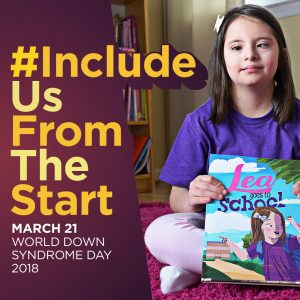
You can read our Media Release about the “Lea Goes to School” video and the #IncludeUsFromTheStart campaign. The campaign website www.includeusfromthestart.com provides further information about the global effort for the promotion of inclusive education.

[Cover photo © Sacha Styles]

Thank you for visiting our website.  You can also keep up with our mission by liking our Facebook page or following us on Twitter @allmeansallaus
Filed Under: News

Media Release: All Means All  participates in International World Down Syndrome Day 2018 Video Campaign – “Lea Goes to School”

March 18, 2018 by allmeansall Leave a Comment

All Means All

All Means All  participates in International World Down Syndrome Day 2018 Video Campaign

“Lea Goes to School”

All Means All – The Australian Alliance for Inclusive Education is proud of its participation in this year’s international World Down Syndrome Day (21 March) #WDSD18 video campaign led by CoorDown, Italy’s national Down syndrome association.

With the creative and communications talent of Luca Pannese and Luca Lorenzini of Publicis New York, together with the support of Down Syndrome International, Down Syndrome Australia, Down’s Syndrome Association (UK), Movimento Down (Brazil) and All Means All, and with the the patronage of the UN Special Rapporteur on the Rights of Persons with Disabilities, CoorDown has delivered yet another powerful video advocacy campaign to advance the rights of people with Down syndrome.

This year’s video takes the form of an animated children’s book story entitled Lea goes to school – read by Grace, a 10 year old child with Down syndrome.

The video can be viewed here.


The core message of the campaign is that inclusive education is a human right and that it is time to remove the systemic and cultural barriers to students with Down syndrome and other disabilities realising this critical human right.

The goal of the campaign, reflected in the hashtag #IncludeUsFromTheStart and supported by the information website www.includeusfromthestart.com, is to highlight the importance for students with disability of accessing an inclusive education from the beginning of their educational experience in determining academic and social life-long outcomes, influencing acceptance and respect for diversity and maximising their future participation in the community and life generally.

This goal is in alignment with the work of All Means All in progressing the implementation of an inclusive education system and the removal of the barriers that limit the rights of some students, including many students with disability, to access a quality inclusive education in Australian schools.

A children’s story with a powerful message

The story of Lea Goes to School is short but in its simplicity it presents a number of important themes and messages:

  • In being narrated by a young girl with Down syndrome it recognises that the right to inclusive education is a fundamental human right of the child – as recognised by Article 24 of the United Nations Convention on the Rights of Persons with Disabilities (to which Australia is a party) and UN General Comment No. 4 on the Right to Inclusive Education. The story book is the creative “device” that allows this serious message to be delivered through the voice of a child.
  • The opening statement that the child protagonist is at a “cross roads” introduces the fact that for many children around the world the direct path to an inclusive education in a regular classroom amongst their same-age peers is crossed by a diversionary lower trajectory “special” education path that, as research demonstrates, more often leads to social isolation and segregated work and living settings.
  • The talking sign-post that stands at the fork in the path and recommends the separate segregated education path through life represents the systemic and cultural barriers to students accessing a genuinely inclusive education.
  • The statement by the child protagonist to the sign-post, “I’m not special. I’m Lea!” challenges the euphemistic foundation and logic of the “special” path and emphasises the importance of educational settings and teachers seeing and responding to each child for the individual that they are.
  • The young protagonist’s intuitive rejection of the “easier” low-expectations “special” path underscores the artificiality of the “special” path and the importance of students with disability being academically challenged and held to high expectations.
  • The simplicity of the story is also reflective of the simplicity of inclusion as a cultural concept and goal – ultimately inclusion is about being a valued part of one’s community. The achievement of that goal is incompatible with segregation of people with disability, in education, employment or other settings.

Over 40 years of research-based evidence shows that inclusive education – a system in which every student is welcomed and supported and where all students learn together in regular classrooms – maximises academic and social outcomes for all students, not just students with disability.

Inclusive education does not happen by itself – students must be properly supported to access the classroom curriculum and teachers and school staff must also be supported, trained and resourced.  It requires the progressive systemic and cultural transformation of our “dual pathway” general and special education systems into a single genuinely inclusive, fully accessible and properly resourced system.  That transformation – the removal of the systemic and cultural barriers – begins with acknowledging the right of every child to receive an inclusive education.

Dr Robert Jackson, co-Founder and a Director of All Means All: “We know that children with Down syndrome are among the most excluded and segregated in Australia’s education system and society and World Down Syndrome Day is an opportunity for us to champion their educational rights and to raise consciousness about inclusive education as a fundamental human right of every child.  The message of the video reflects what we know from decades of research, that educational experiences are critical in determining the life-long trajectory for children with disability and that an inclusive education is the most direct path to a better future for them.”

Ms Catalina Devandas, UN Special Rapporteur on the Rights of Persons With Disabilities: “Access to quality education is essential for children with disabilities to be able to effectively participate in the community. It is a fundamental human right, and one of the keys for ending poverty and making our societies more just. We must all be committed to ensure that schools are inclusive of children with disabilities.”

All Means All – The Australian Alliance for Inclusive Education is a nationwide multi- stakeholder alliance working together for the implementation of an inclusive education system in Australia. You can read more about us here:  www.allmeansall.org.au

World Down Syndrome Day is an international event – officially ratified by a UN resolution – created to raise greater awareness and understanding about Down syndrome, usher in a new culture that embraces human diversity and promotes respect and inclusion in society for all people with Down syndrome.


[Photos © CoorDown]

Thank you for visiting our website.  You can also keep up with our mission by liking our Facebook page or following us on Twitter @allmeansallaus
 

Filed Under: News

Rejecting life on the margin – our path choosing inclusion

March 17, 2018 by allmeansall Leave a Comment

By Lisa Bridle

The day after my son Sean was born, my mother-in-law (undoubtedly a force of nature!) said to me: “I have called the Down Syndrome Association and he can go to a regular school you know”.  At that stage, our precious baby boy was barely clinging to life in the neonatal intensive care unit so I thought she was getting a little ahead of herself.

My next stroke of luck was that the new parent support person from the local Down Syndrome Association who we met when Sean was 8 weeks old shared her stories of her son’s inclusion.  Her life (and her son’s life) did not seem like the isolating tragedy I was imagining, so I decided I might do well to follow her example and learn more about school inclusion.

From this start, even though we didn’t know it yet, my husband, Terry, and I were questioning the idea that Sean’s life path had to be a “special” path determined by his diagnosis.  We were resisting our own misguided stereotypes and starting to see Sean without the filter of dreaded fantasies.

When we really saw Sean as he was – we fell utterly under his spell.  Sean was charming, sociable, funny and determined.  While we felt that he deserved the same life opportunities as his bigger sister, Milly, we came to realise that this is made harder by histories of prejudice, institutionalisation and inferior treatment. But we were stubborn enough to believe that not only was this his right, but that we would be doing others a favour by ensuring his presence.

Inclusion is, of course, not just about “rights”.  It is about being known and belonging in a local community so it was obvious to us that he needed to be included — in childcare, kindy, pre-school and then school.  Mostly entry was easy, but along the way we needed to challenge the “one hour a week” enrolment in preschool initially offered to us and to resist the kindly pressure by guidance officers to enrol in a special school many suburbs away from our home.

This first test of our commitment made us realise that Sean’s participation was not guaranteed but very much “conditional”.   Knowing though that separating children with disability was a historical habit helped us feel stronger in our advocacy; we chose a school without a special education unit and insisted that Sean be really included (not just placed in the classroom) by being challenged to learn.

Sean’s primary years were not a perfect replica of our vision for him – at times, he was groomed to be dependent on teacher aide support rather than included alongside his peers, and sometimes we saw the impact of low expectations.

Despite the gap between a truly inclusive model and what we experienced, the school community was overwhelmingly welcoming.  Sean was a full member of his classes and was loved and embraced by students, parents, and staff.   He participated fully in the life of the school and left primary school with real enduring friendships– friends that he still phones, Facebooks and sees regularly for parties, lunch, movies, and more.

Looking back, I would say that sometimes the people who were meant to support Sean’s inclusion were the biggest barrier. Mostly the classroom teachers got it right, while the “specialist” teacher brought forward unhelpful conversations about the “widening gap” and later scuttled chances for Sean to attend the high school of our choice.

When Sean’s enrolment was rejected at the school we wanted, and we met dead ends elsewhere, we reluctantly agreed to enrol in a regular school with a special education unit some distance from home. When the school started talking about Sean participating in shopping and “life skills” on a Friday and work experience in a sheltered workshop, I knew we had to get out!  Sean was able to move to a new school in walking distance from our home and where some boys from his primary school had gone. With an exceptional teacher at first, I thought we had arrived at inclusion nirvana but she moved on and testing times arrived.

In Years 9 and into Year 10, we were called to a series of school meetings where it was patiently explained to us that our chosen school was not right for Sean, and so they would provide a list of appropriate alternative schools – “special protective environments designed for children like these”.  When we resisted, we were judged as hopelessly unrealistic parents. The school’s determination to force us out included a threat to just suspend Sean for longer and longer periods until we had no choice but to give up.  At this point, we cited disability discrimination laws and reminded the Principal that we would fight to ensure our son’s rights were upheld.

Strangely, through this time I never re-thought the choice about inclusion – and despite these struggles, Sean strode into that school with a stubborn confidence. While disappointed with the school, I understood that this was a steep learning curve for them and recognised that, after centuries of exclusion, the inclusive path is not always easy – but always worth taking.

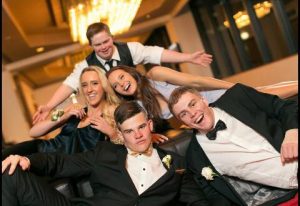
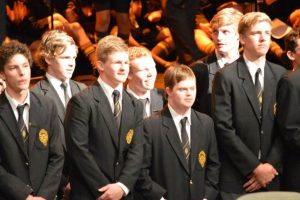
Once we established that Sean was not going anywhere, the school finally agreed to focus on how Sean could develop stronger roles and connections.  He had some wonderful teachers, favourite subjects and great friends. He took his friend, Harriet, to the Senior formal and post-formal party and Terry and I were so very proud to see him at his Graduation ceremony – as he confidently walked across the stage in his Senior shirt, tie and blazer. He left school with a strong sense of himself, a pride in his school and loyalty to his tribe!
Sean is revelling in life after school.  He works three mornings a week as a valued member of the “operations team” in a large NGO and has a second part-time job at the local Convention Centre.    Both jobs are paid at above award wages.  He is a leader at his church youth group, and is a recreational boxer, gym member, swimmer, and enjoys catching up with friends, learning new skills, and heading to the pub. He has studied hospitality and last year attended the University of Queensland studying Australian history.   He has travelled extensively and will move into his own unit later this year.

I have no doubt that his school inclusion – imperfect as it was – has helped Sean to build a strong sense of self built on being in the real world and high expectations based on the role models which surrounded him through school.  The most important legacy of his school inclusion, however, is the rich foundation of friendship he has built – the friendships and social life – based on shared history and fun childhood memories.
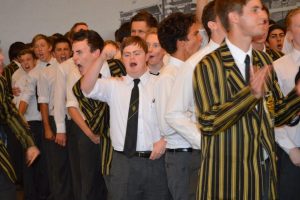
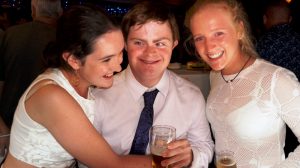
Two years ago now, Sean turned 21 – and more than half his primary school year turned up to celebrate and more than 30 of his high school friends – not to mention all the other friends accumulated along the way.   He has gone on to celebrate those friends’ birthdays and other ordinary rites of passage.  These young people (some of whom he met when he was 5) value Sean’s company, particularly his sense of humour and fun, but also the different perspectives they have from knowing someone like Sean – they are convinced that inclusion is natural, “right” and something that has enriched their life.

We have a choice about which side of history we want to be on.  Trying to build inclusive communities, while separating children on the basis of disability, is untenable – illogical, unnecessary, damaging and out of step with fundamental obligations under the UN Convention on the Rights of Persons with Disabilities.

As parents we need to play our part in resisting the harmful habits of the past.  I don’t underestimate the challenge of this or judge parents for their choices in the face of exclusionary systems, but I would encourage parents of children with Down syndrome to stand strong for their children’s rights.

By standing together as families we can stubbornly resist our children being pushed to the margins.   We need to focus not on “special needs” but on what our children have to offer and equally we need to trust in the capacity of the community to offer friendship and welcome.  Achieving inclusion won’t be perfect or without challenges; we are, after all, still at the start of a social transformation, but Sean’s life, in its rich ordinariness, tells me that an included life is both possible – and absolutely worth it!


[Cover photo and other photos © Lisa Bridle]

Thank you for visiting our website.  You can also keep up with our mission by liking our Facebook page or following us on Twitter @allmeansallaus

Filed Under: News

Victoria’s New “Students With A Disability” Initiative: A Mixed Review

February 5, 2018 by allmeansall Leave a Comment

All Means All

5 February 2018  

MEDIA RELEASE  

SUMMARY: The new Victorian Education Department’s “Students With A Disability” policy is a welcome development along the road to an inclusive education system but falls short of meeting Australia’s international human rights obligations and the interests and expectations of students with disability and their families.

While purporting to support inclusive education in Victoria, funding is increased for segregated education initiatives and there is limited apparent awareness of the distinction between inclusive education as internationally defined, and common educational practices that exclude, isolate and segregate students on the basis of disability.  Segregation is contrary to decades of research, the interests of students with disability, the wishes of many parents and Australia’s human rights law obligations.

The Victorian Government’s new policy falls far short of addressing these issue although it is an encouraging start.


Victoria’s New “Students With A Disability” Policy – A Mixed Review 

All Means All – The Australian Alliance for Inclusive Education  welcomes the Victorian Government’s initiative to publish a new  “Students With A Disability” education policy.

We are encouraged by the Victorian Government taking steps in support of inclusive education in its new policy, which begins with the following statement. 

“The Department is  committed to  embedding inclusive education in all school environments for students with disabilities and additional needs.” 

We also congratulate the Victorian Government’s acknowledgement of the need for a human rights focus, the importance of legal obligations and the need for approaches to be evidence-based.

We are pleased to see Victoria’s “Students With A Disability” education policy alongside a range of recent initiatives in other States that seek to move towards the implementation of an inclusive education system. 

However, we are concerned that the policy is too nebulous to effectively support its intent, and that it should be strengthened by providing clarity about what is “inclusive education” and supplemented with guidance about implementing the change it seeks to drive. 

In this regard, for over a decade now, Australia has receded as segregation of students with disability has in fact increased across our education system, despite the apparent commitment by our governments at international law, domestic law and policy levels  (Australian Bureau of Statistics. 2013, view here showing 17% disproportionate increase in segregated special schools between 1999-2013; see also Disability in Australia: changes over time in inclusion and participation factsheets: community living, education and employment).

A range of factors are consistently identified, including the self-preserving impact of vested interests within our segregated ‘special’ education system and the general ‘mainstream’ education system resisting the necessary change to include students with disability – in effect a systemic reluctance to fully transform our education system so that it respects, offers and implements inclusive education rather than minimalist and largely ineffective “adjustments” to our system.

Minor adjustments ostensibly justified on the basis that parents, disillusioned by the limited ‘inclusion’ on offer, prefer segregated ‘special’ education options. Segregation is not  usually  the ‘first choice” of parents of students with disability,  but a response to discriminatory and poor inclusive  practices in general  schools.    In fact, recent Australian research (2017)  confirms alarming levels of “gatekeeping” (resistant ‘informal’ practices to mainstream enrolment), with 70% of participants reporting discrimination, including denial or discouragement of enrolment or restrictive practices.   

The principal function of policy is to give government officers and relevant stakeholders a clear direction on which to base everything, from day-to-day operations to major planning initiatives.  For this to occur, a policy document needs to be very clear and comprehensive enough that, on the one hand it can’t be misunderstood, and on the other hand it is flexible enough to allow initiatives within the appropriate framework.   

We believe that the current expression of Victoria’s policy should be amended to insert a definition of inclusive education consistent with Article 24 and   General Comment No. 4.    

Relevantly, Article 24 states that in respect of the right to inclusive education that: 

“[i]n realizing this right, State Parties shall ensure that: 

a) Persons with disabilities are not excluded from the general education system on the basis of disability, …; 

b) Persons with disabilities can access an inclusive, quality and free primary education and secondary education on an equal basis with others in the communities in which they live; 

c) Reasonable accommodation of the individual’s requirements is provided; 

d) Persons with disabilities receive the support required, within the general education system, to facilitate their effective education; 

e) Effective individualised support measures are provided in environments that maximize academic and social development, consistent with the goal of full inclusion.” 

We are also concerned that the announcement of “$61 million for a suite of inclusive education initiatives including new equipment and programs” would seem to earmark substantial funds for segregated ‘special’ education schools and initiatives that cannot be properly characterised as inclusive education.  In this regard, two of the three schools named to receive $7.5 million to run after school hours care and school holiday programs are segregated “special” schools (i.e. Yarrabah School  and Kalianna School Bendigo.  While this funding is intended to support students with disability and their families, it is not appropriate to characterise this as an inclusive education initiative and it calls into question how much of the proposed $61 million will support genuine inclusive education for students with disability. 

We also note that this funding seeks to support scholarships for postgraduate studies in “special education” and in a Master of Education (Applied Behaviour Analysis) at a Victorian University.  While studies in inclusive education at tertiary level are sometimes loosely categorised as “special education”, in many cases this refers to the delivery of educations services to students with disability in segregated settings and we would hope that the scholarships initiative is used exclusively to support the upskilling of educators in the delivery of education to students with disability in general education settings using best inclusive practices.  

In addition, the delivery of Applied Behaviour Analysis, which highly contentious among many Autistic self advocates, is also not recognised as inclusive practice. 

The term “inclusive” is not a euphemism for “disability” and an education initiative relating to students with disability should not simply be characterised as “inclusive” unless it in fact legitimately supports the inclusive delivery of education services to students with disability.  

Initiatives that support the delivery of education services in education environments separate or segregated from the disabled students same-age ‘typical’ peers cannot be characterised as “inclusive”. 

All Means All believes that the Victorian Government should provide greater information and transparency about how and the extent to which its $61 million package supports the inclusive delivery of services for students with disability.  

The Victorian Government’s new policy should also be strengthened by providing: 

  • Clarity about the meaning of ‘inclusive education’ and the human rights imperative that underpins it. 
  • Explicit guidance about the legal framework that applies in accordance with the Disability Discrimination Act 1992 (Cth). 
  • A clear goal to achieve de-segregation, by ceasing to build more segregated school, units and programs and set a goal for the shutting down of current segregated settings. 
  • Acknowledgement of the barriers to inclusion and direction about how they can be overcome or circumvented. 
  • A commitment to invest in upskilling teachers and education staff about inclusive education.  This should include pre-service and in-service training, including cultural training. 
  • A commitment to develop pathways to involve families in the inclusive education process at a systemic, school and class level. 
  • Clear goals for monitoring achievement, including a commitment to transparent processes of evaluation.   

We commend Premier Daniel Andrews’ statement that: 

“This is about giving every child every chance to succeed. It’s what’s right, it’s what’s fair – and we’re getting it done.”  

However, we also call on the Premier to recognise that 40 years of research has shown that students with disability are disadvantaged by segregated education and that they have a fundamental human right to receive a quality and genuinely inclusive education – and urge the Premier to lead the implementation of a genuinely inclusive education system in Victoria, consistent with the principles applicable under the  UN Convention on the Rights of the Child and   the Convention on the Rights of Persons with Disabilities  (as clarified by    General Comment No. 4 ) ,  reflected in the   Disability Discrimination Act 1992  (and the  Disability Standards for Education 2005  established under it) and in alignment with the priorities of the  National Disability Strategy 2010-2020  for an inclusive Australian society.

___________________________________________________________

All Means All  is the  The Australian Alliance for Inclusive Education.  We are a multi-stakeholder alliance of people and organisations working together for the implementation of an  inclusive  education system and the removal of the legal, structural and attitudinal barriers that limit the rights of some students to access an  inclusive education in regular Australian classrooms. 

You can visit our website for more information at  www.allmeansall.org.au 

For media queries contact  hello@allmeansall.org.au 

Filed Under: News

Rebranding segregation – a rose by any other name …

December 19, 2017 by allmeansall Leave a Comment

The European Commissioner for Human Rights, Nils Muižnieks recently commented upon the failure of many European countries to understand their obligations under the United Nations  Convention on the Rights of Persons with Disabilities  (CRPD) – including in relation to the right to inclusive education under Article 24.

He also identified the practice of “rebranding” of segregated education to avoid committing to make education systems genuinely inclusive:

 “[C]ountries appear to be willing to settle for some form of segregation and rename segregated forms of education under a more acceptable brand (such as ‘appropriate education’ in the Netherlands) or even as inclusive education (for instance ‘inclusive education centres’ in Romania).”

The Commissioner made these comments just prior to releasing his position paper reviewing the last 5 years of the implementation of Article 24 of the CRPD across European jurisdictions, entitled “Fighting School Segregation in Europe through Inclusive Education”.  That paper notes that:

“Separate schooling of children with disabilities is a widespread practice across Europe notwithstanding the fact that Article 24 of the UN Convention on the Rights of Persons with Disabilities (UNCRPD) imposes on states a duty to ensure that children with disability can access ‘an inclusive, quality primary and secondary education on an equal basis with others in the communities in which the live.’” [p7]

Article 24.1, which also applies to Australia as a State Party to the CRPD, provides that “State Parties shall ensure an inclusive education system at all levels … .”

Article 24.2 of the CRPD further requires State Parties to ensure that:

  1. Persons with disabilities are not excluded from the general education system on the basis of disability, …;
  2. Persons with disabilities can access an inclusive, quality and free primary education and secondary education on an equal basis with others in the communities in which they live;
  3. Reasonable accommodation of the individual’s requirements is provided;
  4. Persons with disabilities receive the support required, within the general education system, to facilitate their effective education; and
  5. Effective individualised support measures are provided in environments that maximize academic and social development, consistent with the goal of full inclusion.”

The meaning of “inclusive education” and the scope of Article 24 were recently clarified in  General Comment No. 4 which was issued on 26 August 2016 by the United Nations Committee on the Rights of Persons with Disabilities (Committee).  General Comment No.4 highlights the need to distinguish between  “exclusion”, “segregation”, “integration” and “inclusion” and provides definitions for those terms (paragraph 11).  Notably, it provides that:

“Segregation occurs when the education of students with disabilities is provided in separate environments designed or used to respond to a particular or various impairments, in isolation from students without disabilities.”

Ambiguity as to what is meant by “inclusive education” has, to some extent, complicated efforts to implement inclusive education systems.  It has certainly made it easier for systems that are averse to change and desegregation to argue that educational segregation of students with disability is a legitimate part of an inclusive education system (see “Towards inclusion: an Australian perspective” (2007), Fiona Forbes).  It has also contributed to the “rebranding” of segregated models in seemingly more “palatable” guises, especially in light of increasing calls for the implementation of inclusive education from a moral, human rights and best evidence perspective.

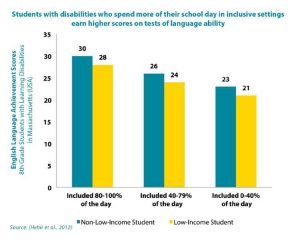
For over 40 years, the body of relevant research into education of students with disability has overwhelmingly established that inclusive education produces superior social and academic outcomes for all students.   Further, the research has consistently found that academic and social outcomes for children in fully inclusive settings are better than in segregated or partially segregated environments where children are segregated for part of their school day.

Source:  “A Summary of the Evidence on Inclusive Education“ (2017).

General Comment No. 4 has now made it clear that education in segregated settings, whether separate special schools or special support units co-located with a regular school, is not “inclusive education” within the meaning of Article 24.

There is a wide range of names that are sometimes given to segregated education facilities or classrooms across the Australian education system.  If you are unsure whether a segregated environment is being proposed for your child, either for all of their school time or for part of it, it is important to ask questions to identify the nature of the arrangement, regardless of what it is called.  At a fundamental level, is your child being grouped with other students with disabilities in separate environments in isolation from students without disabilities?  If so, then education is going to be delivered to your child in a segregated setting to the extent that they are within that separate setting, which is incompatible with their right to an inclusive education.  The fact that the separate segregated setting may be co-located with or even within a regular school does not make the setting “inclusive”.

The following are some examples of names that are given to segregated education settings for students with disability or where students who are labelled as having learning or behaviour issues are segregated – in some cases they are “official” names, in others they are the “colloquial” names used by educators, students and families.

ACT:

Achievement Centre

Flexible Learning Centre

Learning Studio

Learning Support Centres (LSC)

Learning Support Units (LSU)

Learning Support Units Autism (LSU-A)

Multi Categorical Class

Specialist School

Northern Territory:

Autism Spectrum Disorder (ASD) Program

Specialist Centre

Specialist Program

Specialist School

New South Wales:

Disability Program

Early Intervention Unit

Education Support Unit (ESU)

Emotionally Disturbed (ED) Class

Learning Program With Specialised Staff

Personalised Learning and Support

Reading Recovery Program

School for Specific Purposes (SSP)

Special Class

Special Needs Support

Specialist Support Class

Special School

Support Class

Support Unit

Life Skills Class

Queensland:

Alternate Class (A1)

At-School Camp (Autism Program)

Diverse Learning Program

Early Childhood Development Program (ECDP)

Education and Therapy Centres (Autism Schools)

Individual Curriculum Plan (ICP) Classes

Learning Enrichment Centre

Life Skills Program

Resource Centre

Structured Learning Environment

Special Assistance School

Special Education Program (SEP)

Special Education Unit (SEU)

Specialist School

Technology Club (Autism Program)

South Australia:

Autism Intervention Program

Disability Unit

Education Centre

Inclusive Preschool Program (IPP)

Interception Room

Life Education Curriculum/Class

Nurture Class

Oral Aural Unit

Special Education Centre

Special Needs Centre

Special Options Class

Special School

Victoria:

Learning Support Unit/Class

Special Developmental School

Specialist School

Western Australia

Education Support Centre

Education Support Primary School

Education Support Unit

Inclusive Learning Unit

This not an exhaustive list, but some examples that have been provided to us by families and educators.  If you are aware of any other names for these types of settings, please contact us so that we can continue to add to this list.

[Cover photo © Anton Sukhinov]

Thank you for visiting our website.  You can also keep up with our mission by liking our Facebook page or following us on Twitter @allmeansallaus

Filed Under: News, Parent Resources, Resources

All Means All – Submission on Draft General Comment No. 6 on Article 5 (Equality and Non-discrimination) UN Convention on the Rights of Persons with Disabilities

December 9, 2017 by allmeansall Leave a Comment

All Means All

Submission  

Draft General Comment No. 6 on Article 5 (Equality and Non-discrimination) of the Convention on the Rights of Persons with Disabilities (CRPD)  

30 November 2017

You can read this Submission on the United Nations Human Rights – Office of the High Commissioner here.


INTRODUCTION

  1. All Means All is the Australian Alliance for Inclusive Education, a nationwide multi-stakeholder alliance working together to implement an inclusive education system and remove the legal, structural and attitudinal barriers that limit the rights of some students to access full inclusive education.
  2. All Means All commends the work of the Committee on the Rights of Persons with Disabilities (the Committee) in seeking to develop General Comment No. 6 as guidance for State Parties in implementing their obligations under Article 5 of the CRPD and to clarify the inter-relationship between Article 5 of the CRPD and the other more subject-specific Articles of the CRPD.
  3. All Means All thanks the Committee for the opportunity to make a submission on Draft General Comment No.6, and in particular to comment upon the relevance of Article 5 (Equality and Non-discrimination) to the right to an inclusive education under Article 24 (Education), as recently clarified by the Committee in General Comment No. 4 (Right to Inclusive Education).


COMMENTARY

  1. All Means All has had the opportunity to consider, in particular, the following submissions in relation to Draft General Comment No. 6:

–        Australian Government – submission dated 15 November 2017;

–        Children and Young People with Disability Australia – submission dated November 2017; and

–        Queensland Advocacy Incorporated – submission dated 14 November 2017.

  1. All Means All endorses generally the submissions of Children and Young People with Disability Australia and Queensland Advocacy Incorporated. In particular, All Means All, with a focus on inclusive education, agrees that:

(a)          Draft General Comment must recognise the obligation of State Parties under Article 5 to replace Medical Deficit Model-based laws and policies

The medical deficit model in relation to disability, which as the Australian Government submission acknowledges continues to underlie a number of Australian Commonwealth and State laws and policies (including in the education context), perpetuates continued inequality and discrimination against people with disability and reinforces attitudinal barriers to inclusion, equality of opportunity and full participation of people with disability.  The medical deficit model, being inconsistent with the human rights model of disability and the principles of inclusive equality and substantive equality of opportunity, upon which the CRPD and in particular Article 5 is based, is counter-productive to the extent it continues to underlie the form or operation of domestic laws, policies and practices and must be systematically and immediately removed and replaced by State Parties in discharge of their obligations under Article 5.

This requirement for systemic review and replacement of medical deficit model concepts should be clearly and positively incorporated into the General Comment.

(b)          The General Comment should contain Specific and Fuller Articulation of Exclusionary and Segregating Education Practices as being Discriminatory

The failure of State Parties to provide access to genuinely inclusive education in general education classroom settings and equality of educational opportunity and to implement effective is discriminatory and not only a breach of Article 24, but also a breach of Article 5.

Although the Draft General Comment in paragraph 72 “calls on State Parties to be guided by … General Comment No. 4” on the Right to Inclusive Education in fulfilling their obligations under Articles 5 and 24, All Means All submits that the final General Comment should itself identify and articulate the full cross-section of segregating education practices, from segregation in separate “special” schools or units to micro-segregation or micro-exclusion within the walls of a regular classroom, as well as specifying that the use of restrictive practices in the education context is itself a form of discrimination and amounts to denial of equality of opportunity.

In Australia, following its ratification of the CRPD, the education of students with disability in segregated settings has in fact increased relative to education in general education classroom settings[1] and segregated settings and segregated education practices are being rebranded as “inclusive education centres” and “inclusive education practices”[2].

These developments are not specific to Australia.  Given that the research evidence has demonstrated for many decades that segregation in education and restrictive practices mark the commencement of the low-expectations pathway to social and economic exclusion, discrimination and the denial of equality of life-long opportunities[3], the interaction between Article 5 and segregating and exclusionary education practices warrant specific and more comprehensive treatment in this General Comment.

(c)          Domestic Law tests for “Discrimination” are too narrow, limited and focus on formal equality of treatment of individuals, rather than substantive and systemic                           equality in opportunity

Australian federal and State anti-discrimination laws purport to support the equality and non-discrimination of students with disability in education.  However, despite repeated reviews of the Disability Standards for Education 2005 made under the Disability Discrimination Act 1992 (Cth), recent research suggests the discrimination of students with disability is pervasive and lacks effective complaint mechanisms and sanctions to be responsive to grievances of individuals, and even less so to systemic issues[4].

All Means All repeats the succinct and accurate description by Queensland Advocacy Incorporated [para 12] of the key failings of Australian anti-discrimination laws that purport to further, amongst others, the provisions of Articles 5 and 24 of the CRPD:

“a)          A predominantly individualistic approach to a systemic problem;

b)          an inappropriate test (the comparator test) is used to identify discriminatory action;

c)          the model aspires to achieve formal, rather than substantive, equality;

d)          there is a focus on negative, rather than positive or affirmative, action;

e)          the lack of effective sanctions or remedies; and

f)          the exceptions, exclusions and exemptions narrow the scope of the laws.”

All Means All also repeats the submission of Children and Young People with Disability Australia [para13] for the Draft General Comment to emphasise the need for the focus to be on the substantive “effect” of domestic laws, policies and practices on discrimination against and equality of opportunity of people with disability, including students.

It is critical to recognise the vulnerabilities of students with disability who suffer discrimination, and their families. These vulnerabilities can mean that it is more difficult for them to assert rights and complain about discrimination under the current system. In particular, many parents are reluctant to bring complaints if they want to maintain a relationship with the discriminator, whether a school, school Principals or educators. Further, the costs and time periods involved in achieving redress through legal means are significant roadblocks.  Too often, parents are not made aware of their children’s educational rights and are not in a position to identify that discrimination has occurred in the first place.

Appropriate mechanisms that provide for independent, effective, accessible, transparent, safe and enforceable complaints mechanisms and legal remedies in respect of discrimination in the provision of education to students with disability must be made a priority for reform.

Further, advocacy organisations should be provided with the ability to bring complaints of systemic discrimination, to remove the burden from individuals and address systemic and repeat incidents of discrimination.

(d)         The Draft General Comment must strongly emphasise the relevance of the framing of broader governmental and health policy and the media’s portrayal of people with disability to the entrenchment of cultural attitudinal barriers to the realisation of equality and non-discrimination under Article 5

All Means All supports the submission of Children and Young People with Disability Australia [paras 5 and 8] that it would be instructive and beneficial for the Draft General Comment to include positive guidance on framing laws policies and media discussion concerning disability in a manner:

–        conducive to a rights-based or ‘rights-holders’ approach;

–        consistent with the human rights or social model of disability and principles of substantive inclusion, non-discrimination and equality of opportunity; and

–        respectful of disability as part of human diversity.

Inclusion and belonging in education depends upon positive and systemic cultural acceptance of people with disability as ‘rights-holders’ and equal members of our diverse human family.

______________________________________________________

[1] See Australian Bureau of Statistics 2013, view showing 17% disproportionate increase in segregated special schools between 1999-2013 http://www.abs.gov.au/AUSSTATS/abs@.nsf/DetailsPage/4221.02013 ; see also Disability in Australia: changes over time in inclusion and participation factsheets: community living, education and employment: www.aihw.gov.au/getmedia/34f09557-0acf-4adf-837d-eada7b74d466/Education-20905.pdf.aspx

[2] For example, vested interest in segregated education continue to seek to characterise the idea of a single, universally accessible inclusive education system as “utopian” and advance the position that segregating practices are compatible with inclusive education:

“This misconception that inclusion refers to a place and not a process is very pervasive. The current Australian view is restricted to the concept of an inclusive school as a place where everyone belongs, is accepted, and where special education needs students are supported and cared for by their peers and other members of the school community. This is a Utopian view, where there are no references to the processes and learning environments needed to achieve authentic educational outcomes for all students.” (“Towards inclusion: an Australian perspective” by F Forbes (2007))

[3] See “Inclusive Education – What Does the Research Say?”, All Means All (2017) https://allmeansall.org.au/research/

[4] See “Gatekeeping and restrictive practices with students with disability: results of an Australian survey” (2017), Shiralee Poed, Kathy Cologon and Robert Jackson: https://allmeansall.org.au/wp-content/uploads/2017/10/TIES-4.0-20172.pdf

___________________________________________________________

You can visit our website for more information at  www.allmeansall.org.au 

For queries contact  hello@allmeansall.org.au

Filed Under: News

Queensland Election: Inclusive education means investing in regular schools – not more investment in segregated special education  

November 20, 2017 by allmeansall Leave a Comment

All Means All

20 November 2017 

MEDIA RELEASE 

Queensland Election: Inclusive education means investing in regular schools – not more investment in segregated special education  

All Means All – The Australian Alliance for Inclusive Education welcomes the bi-partisan public commitment to inclusive education for Queensland’s students with disability, made on Friday 10th November, Day 13 of the election campaign, by Queensland Education Minister Kate Jones and Shadow Education Spokesperson Tracy Davis speaking to ABC Radio.  We are pleased to note that this commitment also included implementing the 17 recommendations of the Deloitte Review into Education for Students with Disability.  

We also commend the important work and reform that the Queensland Government has been undertaking to support implementation of an inclusive education system, including establishing the Disability and Inclusion Branch and the Autism Hub and Reading Centre, employing inclusion coaches, a program of inclusive education Masters scholarships for school Principals and investing in training and resource development across the board.  

The State of Queensland can also be proud of schools such as Thuringowa SHS that show how schools can plan for and move from segregated to fully inclusive models and achieve better outcomes for all their students.  

It is reassuring that the major political parties appear to be committed to ensuring the right to quality inclusive education for students with disability, recognised in the United Nations Convention on the Rights of the Child, Article 24 of the United Nations  Convention on the Rights of Persons with Disabilities  (as clarified by UN  General Comment No. 4 on the Right to Inclusive Education) and Sustainable Development Goal 4, and reflected in the the Disability Discrimination Act 1992 (and the Disability Standards for Education 2005 established under it).  This right also aligns with the priorities of the National Disability Strategy 2010-2020 which states “The shared vision is for an inclusive Australian society that enables people with disability to fulfil their potential as equal citizens” and the NDIS goal of full social and economic participation. 

In this context, All Means All is disappointed that, on the same day as the bi-partisan pledge was made in the media, Queensland Labor Leader and Premier, Annastacia Palaszczuk, promised funding for a new $32 million Special School in the Caboolture area.  This comes in addition to government investment in the new Cairns Special School that reportedly cost $26 million and is anticipated to enroll 60 students for the commencement of 2018.  This is very significant resource expenditure that could have been utilised to support teachers to better support students with disability in regular classrooms.  

As UN General Comment No. 4 states, Governments should be transferring resources from the segregated special education system to implement inclusive education in the general schooling system (paragraph 68). 

There is an overwhelming body of more than 40 years of research supporting superior academic, social, economic participation and independence outcomes for students with disability in regular schooling and that has never demonstrated better outcomes from segregated education. That objective evidence underlies a moral and human rights mandate and duty for Australia to progress towards a universally accessible and genuinely inclusive general education system.  

The maintenance of a segregated special system alongside the general system diverts critical funds that should be used in the general school system to support better inclusive practice, undermines the will to include and support students with disability and facilitates “gatekeeping” – usually informal and insidious practices intended to discourage enrollment of students with disability within the general system.  

It is concerning that Australia, against international trends and its own domestic policy commitments, has steadily increased the proportion of students with disability in segregated “special” education over the last 12 years (Australian Bureau of Statistics. 2013, view here showing 17% disproportionate increase in segregated special schools between 1999-2013; see also Disability in Australia: changes over time in inclusion and participation factsheets: community living, education and employment).

This regression was queried in May of this year by the United Nations Committee on Economic, Social and Cultural Rights and should be seen in light of international trends away from segregation.  For example, Italy which has an education system recently ranked by UNICEF well above Australia, abolished segregated special education in the 1970s and has educated all students with disability in regular classrooms for the last 40 years.   

While many politicians, policy makers and school administrators say that there is demand from parents for segregated special settings and that they are only responding to that demand, it is important to note that: 

  • Many parents of students with disability do not have access to  adequate information, research evidence and advice regarding inclusive education versus segregated special settings.  Accordingly, many parents, no doubt hoping to do the best for their children, are not making reasonably informed decisions. 
  • UN General Comment No. 4  on Article 24 is unequivocal that the right to an inclusive education is a fundamental right of the child, a right that transcends the parental “right to choose” (paragraph 10(a)). It is the role of government to protect children from harm, including by taking an active role in educating parents about the longer-term consequences of particular choices. 
  • Segregation is not usually the ‘first choice” of parents of students with disability, but a response to discriminatory and poor inclusive practices in general schools.  In fact, recent Australian research (2017) confirms alarming levels of “gatekeeping”, with 70% of participants reporting discrimination, including denial or discouragement of enrolment or restrictive practices.  Many families that have experienced discrimination and harm flee the general education system, not because of inclusive education but because of the lack of it.   

The challenges faced in the general education system to educate the diverse body of learners representing Australian school children are real and require strong leadership and commitment to the implementation of inclusive school reform, such as upskilling teachers, education assistants and school leaders. The denial of education rights to students with disability, even when dressed up as “parent choice”, can never be the appropriate response. 

While we understand that during an election campaign there is a strong incentive to make commitments in order to bring support from particular groups, we call on all parties in the Queensland State election to continue the great bipartisan work on inclusive education that is occurring and commit to ensuring a single, universally accessible, quality inclusive education system for all students in Queensland, consistent with the best evidence and respect for the fundamental human right of every child to an inclusive education alongside their same-age peers, as the foundation of life-long inclusion and full membership of our communities.  We also call on all parties to reconsider any campaign promises to invest in segregated education for students with disability and invest instead in making Queensland a more inclusive State.

___________________________________________________________

All Means All  is the  The Australian Alliance for Inclusive Education.  We are a multi-stakeholder alliance of people and organisations working together for the implementation of an  inclusive  education system and the removal of the legal, structural and attitudinal barriers that limit the rights of some students to access an  inclusive education in regular Australian classrooms. 

You can visit our website for more information at  www.allmeansall.org.au 

For media queries contact  hello@allmeansall.org.au 

Filed Under: News

Media Release AMA and CYDA – National Survey: Discrimination against students with disability in schools is widespread

November 6, 2017 by allmeansall Leave a Comment

6 November 2017
MEDIA RELEASE
National Survey: Discrimination against students with disability in schools is widespread

A national survey of students with disability has revealed that discrimination against children and young people with disability in our education system is rife.

Students, families and teaching staff across Australia participated in the survey conducted by academics at the University of Melbourne, Macquarie University and CurtinUniversity.

The results released publicly today in a paper titled, “Gatekeeping and restrictive practices with students with disability: results of an Australian survey”, by Dr Shiralee Poed, Dr Kathy Cologon and Dr Robert Jackson, and delivered at the Inclusive Education Summit, Adelaide, October 2017, reveal that more than 70% of students have experienced one or more instances of disciminatory “gatekeeping” or restrictive practices in schools and education systems.

Click here to read IN FULL the joint Media Release by All Means All – The Australian Alliance for Inclusive Education and Children and Young People With Disability Australia.

Filed Under: News

Gonski Panel Review – All Means All Submission

November 3, 2017 by allmeansall Leave a Comment

Submission – Quality Schools

Review to Achieve Educational Excellence in Australian Schools

2 November 2017

All Means All – The Australian Alliance for Inclusive Education


Download printable PDF here 

Executive Summary

We believe that a quality school means a school that welcomes and provides full access to the diverse range of Australian students, on the basis of equal opportunity and non-discrimination.

Further, we hope that this review will appreciate that a quality education system is one that values the potential of every child, including children with disability, and their right to access a quality inclusive education, a fundamental human right as recognised in various international human rights instruments, including:

  • Article 24 of the UN Convention on the Rights of Persons with Disabilities (CRPD) (as clarified by General Comment No. 4); and
  • Sustainable Development Goal 4” to “Ensure inclusive and equitable quality education and promote lifelong learning opportunities for all”.

We submit that the maintenance and continued investment in a “dual system” of education, comprising separate segregated settings for students with disability, whether in “special” schools, co-located education support units or separate classrooms in general education schools, is fundamentally discriminatory, not supported by the research evidence and inconsistent with inclusive education as the modality by which people with disability realise the universal human right to education.

We hope that the Panel has the courage to recommend robust changes to law, policy and practice to ensure that all our schools become inclusive positive learning environments promoting social cohesion, belonging, active participation in learning and a complete school experience with positive peer interactions.

This review presents an opportunity for the Panel to contribute to designing a high expectations and evidence-based inclusive education system that all our children deserve. Its recommendations will be critical to progressing towards a universally accessible and inclusive education system for all Australian students or entrenching a regressive and harmful segregating model of education for students with disability, contributing to greater academic marginalisation and social exclusion.


Human Rights Framework and meaning of inclusive education

Recommendation: Review of the Australian education system, including law, policy and practice, to ensure compliance with international human rights obligations and commitments to inclusive education, including Article 24 of the CRPD and General Comment No.4

Recommendation: Ensure consistent use and understanding of the term “inclusive education” to ensure that measures and practices are evidence-based and compliant with the obligation to implement an inclusive education system

The CRPD was ratified by Australia on 17 July 2008.

Article 24.1 of the CRPD requires State Parties to “ensure an inclusive education system at all levels” and Article 24.2 provides more specifically that persons with disabilities are not to be excluded from the general education system on the basis of disability and that they have a right to access an inclusive, quality education on an equal basis with others in the communities in which they live. Article 24 also mandates reasonable accommodation of the individual’s requirements and for supports to be provided “within the general education system”.

In August 2016, the UN Committee on the Rights of Persons with Disabilities (Committee) issued General Comment No. 4, as a formal guidance instrument on the meaning and scope of Article 24 of the CRPD. Together, Article 24 and General Comment No.4 are the most authoritative instruments on inclusive education as a human right for people with disability.

General Comment No.4 was developed through a near 2-year consultative process starting in 2015 involving stakeholders including Australia.

A key reason for the development of a General Comment on inclusive education was the Committee’s concern, after reviewing a decade’s worth of country implementation reports, of widespread failure to ensure compliance with Article 24, including because of a lack of clarity around the meaning of “inclusive education”.

As recognised by European Commissioner on Human Rights in a recent comment, some of this confusion has arisen through the “rebranding” of segregated models of delivery as “inclusive”:

“In other instances, countries appear to be willing to settle for some form of segregation and rename segregated forms of education under a more acceptable brand (such as ‘appropriate education’ in the Netherlands) or even as inclusive education (for instance ‘inclusive education centres’ in Romania).”[1]

As such, perhaps the most critical clarification in General Comment No.4 is as to the the need to distinguish between “exclusion”, “segregation”, “integration” and “inclusion”.  Paragraph 11 sets out important definitions:

  • “Exclusion occurs when students are directly or indirectly prevented from or denied access to education in any form.”
  • “Segregation occurs when the education of students with disabilities is provided in separate environments designed or used to respond to a particular or various impairments, in isolation from students without disabilities.”
  • “Integration is a process of placing persons with disabilities in existing mainstream educational institutions, as long as the former can adjust to the standardized requirements of such institutions.”
  • “Inclusion involves a process of systemic reform embodying changes and modifications in content, teaching methods, approaches, structures and strategies in education to overcome barriers with a vision serving to provide all students of the relevant age range with an equitable and participatory learning experience and environment that best corresponds to their requirements and preferences.

In this regard, it is important to note that the same phenomenon is observed in Australia where special education organisations such as the Australian Special Education Principals Association continue to advance the position that “inclusion is not a place” and that “special schools” and other segregated models can be legitimately characterised as forms of inclusive education[2], a position that cannot be reconciled with Article 24 of the CRPD, General Comment No.4 or any logical concept of social inclusion.

In his recent report[3], the European Commissioner also noted the tendency for “vested interests” to preserve the status quo and resist inclusive education:

Professional groups involved in special education, such as teachers, psychologists and testing centres frequently oppose desegregation in order to protect vested interests.” [pp 10-11]

A correct understanding and application of these concepts is critical to implementing a genuinely inclusive education system. We believe that government should take a leading and active role in addressing the misuse of “inclusive education” and the rebranding of segregated education as “inclusive”.

Finally, it is important to note that General Comment No.4 is instructive as to the matters that the Committee will consider in their future reviews of compliance by State Parties. In this regard, the Committee in October 2017 issued questions to Australia, including notably:

 “26.  Please explain how the State Party’s new education funding model supports progressive implementation of article 24 of the Convention, including in the light of the Committee’s general comment No. 4 (2016) on the right to inclusive education, which calls for the transfer of resources from segregated to inclusive education settings.”


The experience of students with disability and families

Recommendation: Funds be allocated to support students and families to access an inclusive education, avoid discriminatory practices and ensure that legal obligations are being met

The reality for students with disability in Australia is that, too often, they are offered a “qualified” opportunity to participate in a system established before people with disability were recognised as holders of educational rights and without regard to their functional needs.  That system remains resistant, both culturally and in terms of educational practice, to accommodating their participation and inclusion, particularly for students with intellectual, cognitive or sensory disabilities.

Ten years after the CRPD and notwithstanding the Disability Discrimination Act 1992 (and the Disability Standards for Education 2005[4] enacted pursuant to it), the experience of students with disability in the Australian education system is too frequently one of discrimination and devaluation, isolation, lack of resources and supports, denial of enrolment or other forms of “gatekeeping”[5], inadequately trained teachers, lack of expertise in inclusive practices and inflexible structures and approaches that operate as barriers.  Too often, students with disability experience practices that are not evidence-based, that tend to isolate them and that result in a lower quality educational provision and consequently poor educational outcomes.

A recent study of over 700 families across Australia identified that a staggering 71% of those surveyed reported either “gatekeeping” or restrictive practices[6].

These concerns are backed up by many Parliamentary and departmental inquiries across Australia, notably the national 2016 Report by the Education and Employment References Committee of the Australian Senate into the impact of policy, funding and culture on students with disability[7].

It seems clear that the experiences of Australian students with disability are strongly characterised by systemic “integration”, “segregation” and “exclusion” – not “inclusive education”, as those terms are defined in paragraph 11 of General Comment No. 4.

The continued operation, demand for and growth of a parallel and high-resourced system of segregated education alongside the general education system, evidences systemic failure of the general education system to ensure access and inclusion of every Australian student and a denial of their fundamental human rights.  Reports also suggest significant increases in rates of “home schooling”, particularly for autistic students.

As recognised in the 1954 US case of Brown v Board of Education in relation to racial segregation, the notion of “separate but equal” has no place in education.

“Segregation of white and colored children in public schools has a detrimental effect upon the colored children. The impact is greater when it has the sanction of the law, for the policy of separating the races is usually interpreted as denoting the inferiority of the Negro group…Any language in contrary to this finding is rejected. We conclude that in the field of public education the doctrine of ‘separate but equal’ has no place. Separate educational facilities are inherently unequal” – Earl Warren, Chief Justice of the U.S. Supreme Court

We do not see this reasoning to have different application to students with disability and in fact, when seen against the background of other efforts to make quality education accessible to women or to racially marginalised groups, the denial to whom was considered acceptable in earlier but recent times, many parallels are evident.  In this regard, we believe that segregated education of students with disability is also discrimination hidden in plain sight.

It is particularly disturbing that in the last decade or longer, a period that also coincided with ratification of the CRPD and the introduction of the Disability Standards for Education, there has been significant growth in segregated education of students with disability[8].  This concern has also been expressed at an international level where Australia was asked to explain this by the UN Committee on Economic, Social and Cultural Rights in May of this year:

“Rodrigo Uprimny, Committee Expert and Co-Rapporteur for Australia: “As for persons with disabilities and inclusive education, there was evidence of a rise in segregated education. What measures was the Government taking to ensure inclusive education across the country?”[9]

A week before the above Committee session, the Australian government released a fact sheet showing a 35% growth in segregation of students with disability in special schools alone[10].

As such, while the current and previous governments have expressed their commitment to inclusive education, including through the National Disability Strategy, the growth in segregation speaks to the national failure in education of students with disability.


Evidence basis for inclusive education

Recommendation: Funding only be allocated to evidence based and best practice inclusive education across the education system

Recommendation: The Australian government adopt a national desegregation strategy in relation to education of students with disability and provide systemic funding to support progressive implementation of inclusive education  

For over 40 years, the body of relevant research into education of students with disability has overwhelmingly established inclusive education as producing superior social and academic outcomes for all students.

Italy ended segregated education in 1978 when it closed its special schools and today 99% of students with disability are fully educated in regular classrooms.  More recently, the Canadian province of New Brunswick prohibited segregated education in the public education system through its internationally award-winning legally enforceable Policy 322[11].

The research has consistently found that academic and social outcomes for children in fully inclusive settings are without exception better than in the segregated or partially segregated environments[12].  Unfortunately segregated education remains a historically-entrenched practice that continues to be suggested to families and educators as the appropriate default option, despite having virtually no evidence basis.

In the case of students with intellectual disability, a comprehensive 2008 literature review by Australian academic expert Dr Robert Jackson found that no study has ever demonstrated “special” segregated education to produce better outcomes.[13]

A recent study from the Netherlands reported better academic outcomes for children with IQs of 30-35 in general education than for children with higher IQs of 50 educated in “special” schools.[14]

The most recent comprehensive review of the research was undertaken in an international report entitled “A Summary of the Evidence on Inclusive Education” released in 2017[15], by Dr Thomas Hehir, Professor of Practice in Learning Differences at the Harvard Graduate School of Education, with Abt Associates.

The Report documents the results of a systematic review of 280 studies from 25 countries.

The Report defines inclusive educational settings in accordance with General Comment No. 4.

The Report recognises that growth in inclusive practices stems from increased recognition that students with disabilities thrive when they are, to the greatest extent possible, provided with the same educational and social opportunities as non-disabled students [p4].

The Report also acknowledges the significant barriers of negative cultural attitudes and misconceptions amongst school administrators, teachers, parents (including some parents of children with disabilities) and notes the need for general societal education.

Key findings of the Report include:

1. There is “clear and consistent evidence that inclusive educational settings can confer substantial short and long-term benefits for students with and without disabilities”. [p1]

  • “A large body of research indicates that included students with disabilities develop stronger skills in reading and mathematics, have higher rates of attendance, are less likely to have behavioural problems, and are more likely to complete secondary school than students who have not been included.  As adults, students with disabilities who have been included are more likely to be enrolled in post-secondary education, and to be employed or living independently.” [p1]
  • Multiple reviews indicate that students with disabilities educated in general education classrooms outperform their peers who have been educated in segregated settings. A 2012 study by Dr Hehir examined the performance of 68,000 students with disabilities in Massachusetts and found that on average the greater the proportion of the school day spent with non-disabled students, the higher the mathematic and language outcomes for students with disabilities. [p13]
  • The benefits of inclusion for students with disabilities extend beyond academic results to social connection benefits, increased post-secondary education placement and improved employment and independence outcomes. [p15] Again, there is a positive correlation between social and emotional benefits and proportion of the school day spent in general education classrooms. [p19]
  • The Report states that “…research has demonstrated that, for the most part, including students with disabilities in regular education classes does not harm non-disabled students and may even confer some academic and social benefits. Several recent reviews have found that, in most cases, the impacts on non-disabled students of being educated in an inclusive classroom are either neutral or positive.” [p7] Small negative effects on outcomes for non-disabled students may arise where a school ‘concentrates’ students with severe emotional and behavioural disabilities in the one class (itself a form of segregation). [p9]
  • It further states that “A literature review describes five benefits of inclusion for non-disabled students: reduced fear of human difference, increased comfort and awareness (less fear of people who look or behave differently); growth in social cognition (increased tolerance of others, more effective communication with all peers); improvements in self-concept (increased self-esteem, perceived status, and belonging); development of personal moral and ethical principles (less prejudice, higher responsiveness to the needs of others); and warm and caring friendships.” [p12]

2.  Teaching practice is central to ensuring that inclusive classrooms provide benefits to all students. [p9]

  • Teachers with positive attitudes towards inclusion are more likely to adapt the way they work for the benefit of all students and are more likely to influence colleagues in positive ways to support inclusion. [p9]
  • Research suggests a positive correlation between teacher training and positive attitudes towards inclusion. [p9]
  • Though financial resources matter, implementing inclusive education requires teachers and other educational professionals to regularly engage in collaborative problem solving.  Research suggests that through the development of a culture of collaborative problem solving, the inclusion of students with disabilities can serve as a catalyst for school-wide improvement and yield benefits for non-disabled students. [p10]

A comprehensive meta analysis published in 2017 and covering a total sample of almost 4,800,000 students also found that educating students with disability in general education settings alongside non-disabled peers has no detrimental impact, and some positive impact, on the academic performance of non-disabled students[16].

Last month the European Commissioner on Human Rights argued that the segregation of students with disability –  in special schools, support units or quarantined to the corner of mainstream classrooms – compromises the performance of the general education system:

“Available studies indicate that school segregation has negative implications not only for minority or vulnerable students themselves but also jeopardises the overall performance of education. Tackling school segregation is not only necessary to safeguard the right to education and equality in the education systems, but also key to improving the effectiveness and performance of the education system as a whole. … The countries with the highest index of social inclusion in schools … are also the ones that performed best in the mathematics test in the PISA 2012 survey.  These results are attributed to the ‘peer effect’, namely the positive outcome derived from the fact that students with learning difficulties benefit from sharing the educational space with their more advantaged peers. … Conversely, a high concentration of students with learning difficulties in the same [segregated] classroom lowers educational quality and the expectation of teachers regarding their pupils’ potential for progress.” [p13]


Conclusion

The Australian Government has a duty to ensure that laws, policy and funding progress the implementation of an inclusive education system and are not promoting or maintaining segregating educational practices that are discriminatory, exclusionary and not supported by evidence.

The rise in segregated education and home-schooling is an indictment on the current adequacy of our education system and the need for reform.

___________________________________________

[1] See https://www.coe.int/en/web/commissioner/-/respecting-the-human-rights-of-persons-with-psychosocial-and-intellectual-disabilities-an-obligation-not-yet-fully-understood

[2] https://www.researchgate.net/publication/227643447_Towards_inclusion_an_Australian_perspective

[3] https://rm.coe.int/fighting-school-segregationin-europe-throughinclusive-education-a-posi/168073fb65

[4] The Disability Standards for Education not only fail to even mention “inclusion” or “inclusive education”, they have been in place since 2005, that is for most of the period of 2003-2015 which has seen a significant increase in segregation of Australian students with disability.  https://docs.education.gov.au/system/files/doc/other/disability_standards_for_education_2005_plus_guidance_notes.pdf

[5] “Gatekeeping” is an unconscionable practice and refers to the formal and informal discouragement of enrolment and attendance of students with disability by local mainstream schools, as identified in 2016 Report by the Education and Employment References Committee of the Australian Senate into the impact of policy, funding and culture on students with disability.

[6] https://allmeansall.org.au/wp-content/uploads/2017/10/TIES-4.0-20172.pdf

[7] see http://www.aph.gov.au/Parliamentary_Business/Committees/Senate/Education_and_Employment/students_with_disability/Report

[8] Australian Bureau of Statistics. 2013. Schools Australia. View at: http://www.abs.gov.au/AUSSTATS/abs@.nsf/DetailsPage/4221.02013 Viewed on 15 April, showing that between 1999-2013, there was an increase in special schools of 17% Australia

[9] http://www.ohchr.org/EN/NewsEvents/Pages/DisplayNews.aspx?NewsID=21677&LangID=E

[10] www.aihw.gov.au%2FWorkArea%2FDownloadAsset.aspx%3Fid%3D60129559751&h=ATOjvsdyRLQi2FWQUPRmTNaAUtMSsOK1O1k1xbfxD88_Qo1x2ILZRyO1Mcv-u7SU9PD7xPRGitCiuUU05jY4Wlxe6wfTpgKBLTeyY5yrw-uVqvo4E_1DAw8YfVMHvkuv1fvjKJ-5JZ5_K0BCuojAP2A_vZ3GTpkhG1zReCKG12Do_At17nW4VY-vlsb8NG_0plrsMyRkkx_QozNTDpiLugkgrCHILsF9Q0XA1aZ-unbHAbDjjMqYK_SdJquQ-IQNj2_3p4r3McWk5gTLocnz8mKhCDkNLauGfCfAsEY

[11] See http://www.startingwithjulius.org.au/canada-policy322/

[12] ”Inclusion in Education: Towards Equality for Students with Disability“, Dr K. Cologon, Children and Young People With Disability Australia.

[13] Jackson, R (Ibid), at page 13 stated “No review could be found comparing segregation and inclusion that came out in favour of segregation in over forty years of research”.

[14] de Graaf, G. & de Graaf, E. (2012), Development of self-help, language and academic skills in Down syndrome. Paper presented at 11th World Down Syndrome Congress, Cape Town, South Africa.

[15] http://alana.org.br/wp-content/uploads/2016/12/A_Summary_of_the_evidence_on_inclusive_education.pdf

[16] Academic achievement of students without special educational needs in inclusive classrooms: A meta-analysis“, Grzegorz Szumski, Joanna Smogorzewska, Maciej Karwowski in Educational Research Review 21 (2017) 33e54

___________________________________________


[Cover photo © Chance Anderson]

Thank you for visiting our website.  You can also keep up with our mission by liking our Facebook page or following us on Twitter @allmeansallaus

Filed Under: News, Resources

Leading Learning 4 All: Inclusive Education and “Taking Advice”

October 29, 2017 by allmeansall Leave a Comment

Senator Collins: “[The Leading Learning 4 All website project was] set to fail from the outset.”

Senator O’Neill: “Minister, will you give an undertaking to pause the site?”

Minister Birmingham: “I’ll take advice on that.”

All Means All – together with peak disability organisations such as Children and Young People With Disability Australia, Disabled People’s Organisations Australia, Down Syndrome Australia and others, leading academics, prominent disability advocates, educators and parents of students with disability – altogether approximately 180 organisations and individuals – are signatories to an Open Letter seeking the suspension of the Leading Learning 4 All website resource whilst it undergoes a rigorous independent review.

A response to the Open Letter was released by the Australian Special Education Principals’ Association (ASEPA), the developers of the Leading Learning 4 All website, on the @LL4All Twitter account.

The Open Letter was tabled by the Senate Education and Employment Legislation Committee on 26 October 2017 and the Leading Learning 4 All resource was the subject of questions put by the Senate Committee to the  Commonwealth Department of Education and Minister Simon Birmingham, the federal Minister for Education.  While some questions were taken on notice, we consider more broadly that the answers provided by the Commonwealth Department in relation the concerns raised by the Letter and the Committee members were insufficient.

You can watch the video in full here:

In particular, we note that the federal Minister has undertaken to take advice as to whether the Leading Learning 4 All website should be suspended pending the review and correction of that resource.  In that regard we offer the following.

  • There is a fundamental difference between developing a substandard resource for use by schools that is to be improved over time and developing a sound resource that is to be supplemented over time.  To the extent that it is suggested that deficient modelling of inclusion was presented in the resource for “discussion purposes”, the deficiencies should have been specifically identified for users rather than implicitly endorsed as a federal Government funded and sanctioned resource.
  • There is a fundamental difference between presenting the requirement of developing inclusive general education classrooms as a legal obligation and professional requirement and presenting inclusion in general education as some optional, aspirational or inspirational goal for “champion” school leaders to help promote.
  • There is a fundamental difference between aiming for compliance with the Disability Education Standards 2005 as minimum “access” standards and recognising that a genuinely inclusive education is a fundamental right of all students established by Article 24 of the United Nations Convention on the Rights of Persons with Disabilities to which Australia is a party, the detail of which has been internationally prescribed in 2016 by General Comment No. 4 (Right to Inclusive Education) and which guidance Australia in its submission to the Day of General Discussion on the General Comment welcomed:

“Australia considers that the adoption of a General Comment on the right to education will provide valuable guidance to States in interpreting their obligations under the Convention.” [para 4 of Australia’s Submission].

  • The response to the Open Letter by ASEPA and by the Commonwealth Department in Senate Estimates, and in fact the approach that was taken to the development of such a key inclusion resource by tasking as the lead developer a body whose experience is confined to segregated “special” school settings, suggests:
    • a failure of Australian education administration to model an inclusive and collaborative process for the development of a key resource aimed at the inclusion of students with disability – any such resource must be developed with relevant stakeholders and, notably, in partnership with people with disability and disabled people’s representative organisations;
    • the inappropriate degree of capture that the special schooling system has and is being given on the development of broader and general policy in relation to students with disability being educated in regular schools – rather inclusive education policy must be founded on a best practice and sound evidence base; and
    • the critical need for the Australian education administration, and in particular its senior ranks, to develop a sound understanding of principles and frameworks for inclusive education.
  • The implementation of genuinely inclusive education in Australia depends upon strong and committed leadership to develop an inclusive and collaborative culture in our schools – everything that is done in this space that is weak, equivocal, half-willed or presented as aspirational or inspirational – for “champions” and “promoters” of inclusion – is counter-productive and is likely to entrench the inertia of the status quo and the continued academic and social segregation of our most vulnerable students in “special” settings – to the detriment of their long-term outcomes and inclusion in society.

We respectfully ask that the federal Minister consider these matters.

[Cover photo © Foter]

Thank you for visiting our website.  You can also keep up with our mission by liking our Facebook page or following us on Twitter @allmeansallaus

Filed Under: News, Resources

  • « Previous Page
  • 1
  • 2
  • 3
  • 4
  • 5
  • 6
  • Next Page »

About Us

All Means All is the Australian Alliance for Inclusive Education, a nationwide multi-stakeholder alliance working together to implement an inclusive education system and remove the legal, structural and attitudinal barriers that limit the rights of some students to access full inclusive education.

Want to learn more

Sign up for all the latest news and resources straight to your inbox.

  • Terms of Use
  • Privacy Policy
  • Copyright
  • Accessibility
  • WordPress Site by Meta Creative