Australian Alliance for Inclusive Education

  • Home
  • Contact Us

Australian alliance for inclusive education

  • About Us
    • Who We Are
    • Meet Our Team
    • Our Networks
    • Expertise and Advice
  • For Parents
    • Toolkit
    • SIPN
    • Parent Resources
  • For Educators
    • Toolkit
    • SINE
    • Educator Resources
  • Latest
  • EduBlog

All Means All: Our Submission to the United Nations – Inclusive Education in Australia

October 20, 2017 by allmeansall Leave a Comment

All Means All has made a submission to the United Nations Committee on the Rights of Persons With Disabilities (CRPD Committee) about Article 24 of the Convention on the Rights of Persons with Disabilities (CRPD) and Australia’s obligations under it, which assisted in the Committee’s formulation of the final List of Issues adopted last month at the Committee’s 18th session and which will form the basis of a review of Australia’s compliance with the CRPD in 2018.

All Means All is pleased to see its submission reflected in the final List of Issues, particularly items 24 and 26 which request Australia to provide specific student data separated into segregated and non-segregated settings and an explanation of how the new needs based funding model supports implementation of an inclusive education system especially in light of the CRPD Committee’s calls in General Comment No.4 for the transfer of resources from segregated to inclusive education settings.  All Means All also raised the recommendations of the Senate Education and Employment References Committee’s 2016 Report into education of students with disability and the impact of the Disability Standards for Education.

The following are the items from the final List of Issues that specifically relate to Article 24 and inclusive education:

24.   Please provide updated data on the participation, completion rate, suspensions, use of restraint and seclusion of students with disabilities in both segregated and inclusive classroom settings, disaggregated by age, gender, disability, location and ethnicity.

25.   Please detail the measures taken to:

(a)   Implement the recommendations in the Senate Education and Employment References Committee’s 2016 report, “Access to real learning: the impacts of policy, funding and culture on students with disability”;

(b) Conduct research into the effectiveness of current education inclusion policies and the extent to which the Disability Standards for Education (2005) are being implemented in each state and territory;

(c) Increase funding to ensure the provision of reasonable accommodation for inclusive and quality education;

(d) Increase the accessibility of tertiary education facilities and courses for all persons with disability, particularly deaf persons and persons with intellectual disabilities.

26.  Please explain how the State party’s new education funding model supports progressive implementation of article 24 of the Convention, including in the light of the  Committee’s general comment No. 4 (2016) on the right to inclusive education, which calls for the transfer of resources from segregated to inclusive education settings.

All Means All’s submission also stated its support for the broader List of Issues submission by Disabled People’s Organisations Australia and thanked the Committee for the opportunity to provide a submission specifically in relation to Article 24 of the CRPD.

You can download All Means All’s submission below:

Submission – Australia – Article 24 Committee on the Rights of Persons with Disabilities 18th Session

[Cover photo © Falcon]

Thank you for visiting our website.  You can also keep up with our mission by liking our Facebook page or following us on Twitter @allmeansallaus
 

Filed Under: News

Leading Nowhere: Flawed LL4All Website Must Be Subject to Rigorous Independent Review

October 19, 2017 by allmeansall Leave a Comment

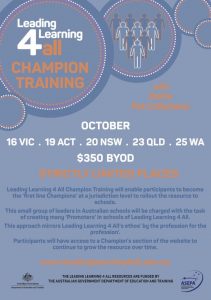
For $350 one can undertake the ‘Champion Training‘ course and become part of a select group of school leaders qualified to roll out the Leading Learning 4 All website resource funded by the Commonwealth government and launched by Federal Education Minister Senator Simon Birmingham early this year.  This select group is “charged” with creating many “Promoters” of Leading Learning 4 All.  In particular, this select group will have access to the ‘Champions’ section of the website to “continue to grow the resource”.

First, the concepts of “Champions” and “Promoters” of a resource that is intended to advance the inclusive education of students with disability must be seen against the fact that students have a right – not a privilege – to access a genuinely inclusive education in their local school and the education system and schools within it have an obligation to deliver that genuinely inclusive education.  It should not be presented as an ideal above and beyond the standard for “heroes” within the education system – it is and should be the standard required to be achieved by all staff within the education system.

Secondly, “growing” any resource intended to better guide the implementation of an inclusive education system must be consistent with the right to inclusive education, based on best inclusive practice and objective evidence and subject to rigorous scrutiny.  Qualifying as a “Champion” is manifestly inadequate to justify participation in “growing” any inclusive education resource particularly given widespread poor practices and fundamental lack of understanding of what is inclusive education, but particularly in the context of a resource that has been identified as flawed from the beginning and that does not from the outset provide a sound framework for delivering inclusive education in our schools.

The Leading Learning 4 All website resource has caused significant concerns and prominent disability advocates, academics and organisations including All Means All and the peak disability representative organisations have written an Open Letter to federal Education Minister Simon Birmingham outlining a range of concerns relating to appropriate language, the promotion of approaches that do not represent best practices in inclusive education, representation of students with disability including inappropriate language, the application of the Disability Standards for Education and the alleged lack of consultation with representative organisations of people with disability and families. The concern has also been raised from overseas, with some UK organisations and experts from as far away as Sweden adding their names to the  letter. 

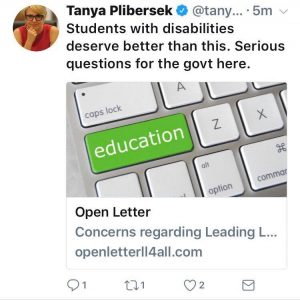
The New South Wales Teachers Federation has now joined calls for rigorous, independent review of the resource and questions have also been raised by Shadow Education Minister Tanya Plibersek as well as South Australian Parliament MP and Leader of the Dignity Party Kelly Vincent MLC who has signed the letter. 

We understand that to date there has been no response to the Open Letter either from Leading Learning 4 All or Senator Birmingham’s Office.   This is a matter of great significance as students and teachers both deserve a quality resource that supports quality inclusive education in our schools and implements anti-discrimination obligations of education providers. 

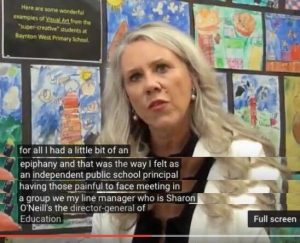
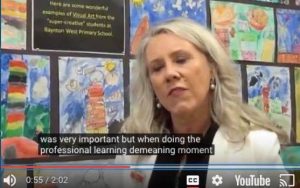
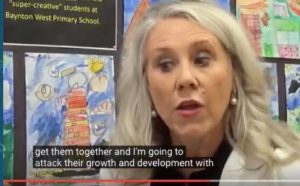
As an example, the following was shared with us by a concerned parent who was on call-waiting and decided to switch off the volume and watch the videos on the website using the close-captioning option instead; “professional learning demeaning moment” … “I’m going to attack their growth and development” and “those painful face to face meetings” were unexpected to say the least, but if you don’t take the time to subtitle properly and ensure quality across the resource you run the risk of detracting from and undermining the outcomes that are being sought to be achieved.

If you would like to read the Open Letter in full and add your name to it, you can see it here and click on the Contact form.

[Cover photo © Stefan Stefancik]

Thank you for visiting our website.  You can also keep up with our mission by liking our Facebook page or following us on Twitter @allmeansallaus
Filed Under: News

Media must stop promoting segregated education as the answer to abuse of children with disability

October 10, 2017 by allmeansall Leave a Comment

[CORRECTION:  When this article was published earlier this week, we were not aware that  Manning Gardens Public School operates a segregated education support for children with disability and the article misidentified the school as “a regular primary school on the NSW mid-north coast, which does not have an education support unit”.  In fact, the Manning Gardens Public School website states “We have a purpose built support unit catering for children with intellectual disabilities or developmental delays”.  This new information reinforces the point that we sought to make, that while the story on 7.30 was framed as the failings of education of students with disability in a regular classrooms, both children attended segregated education supports unit co-located within regular public schools, an important detail that should have been included in 7.30’s report.]

ABC television’s 7.30 featured a story about Austin Franks, a 16-year-old autistic student at Pennant Hills High School being subjected to restraint practices including boxing pads to move him from room to room.

The story was presented in the shocking context of almost 250 reported complaints of mistreatment of disabled children in NSW state schools in the past two years, which are detailed in a government document obtained by 7.30 under Freedom of Information laws.

While the importance of investigative journalism of this nature should be recognised, All Means All has some concerns about how the story was framed and an implication that students with disability are better off in segregated environments, contrary to a large body of research over 4 decades that shows that students with disability educated with their non-disabled peers develop stronger skills in reading and mathematics, have higher rates of attendance, are less likely to be labelled as having “behavioural problems” and are more likely to complete secondary school than students who have not been included.  As adults, students with disability who have been included are more likely to be enrolled in post-secondary education, and to be employed or living independently. In other words, being disconnected from one’s community and same-age “typical” peers comes at a significant cost to disabled students and their families, as well as to society as a whole.

However, the story was introduced as follows:

“Austin would present a challenge for any school.  He is severely autistic, non-verbal and has an intellectual disability.  But Pennant High School in Sydney accepted the responsibility of educating him alongside his mainstream peers.  Thing went terribly wrong.” 

The suggestion being that despite its best intentions of educating Austin “alongside his mainstream peers”, the regular education system had failed.

All Means All understands that Austin in fact attended an education support unit (with a high adult-to-student ratio) co-located with the regular public school. That is certainly not the same as being educated in a regular classroom in a regular school with appropriate support.  It is in fact segregated “special education”, as defined by the United Nations Committee on the Rights of Persons with Disabilities. It is not inclusive education in a regular classroom – which is a fundamental right of all students.

Austin’s mother Caroline Franks then details what she observed and her interactions with her son’s school.

“He would come [home] covered in blood,” Austin’s mother, Caroline Franks, told 7.30 through tears.

“I would ring the school and say ‘what happened?’ And they would say, ‘oh, we don’t know, we don’t know what’s caused it’.

“They failed to mention he was being pushed around with boxing batons or screamed at or not allowed to go to the toilet or access his sandwiches or anything like that.”

7.30 also reported on the story of another child, Thomas Maker-North who was strapped last year into two different types of chairs at Manning Gardens Public School, a regular primary school on the NSW mid-north coast, which does not have an education support unit.  Again, the suggestion is made that the problem is with the regular education system and his mother expresses the view that she now felt she would need to consider a “special school” for her son.  In other words, “special education” is presented as the answer, a point that has been picked up by many people on social media whose response has been to question the fundamental human right of students with disability to attend regular schools and to blame the victims or their families for pursuing educational rights for their children.

But when you scratch the surface of the 7.30 report, Austin’s story is not about the failings of inclusive education in a regular classroom – it is rather an indictment on the special education “strategies” delivered in a segregated education support unit co-located with a regular public school.

It is unclear how Manning Gardens Public School came to decide to use a restraint chair on Thomas Maker-North but All Means All is aware that these strategies are often introduced by “specialist” staff or consultants such as occupational therapists or physiotherapists brought into schools to advise on strategies for students with disability.

It is concerning that 7.30 framed its report on abuse of children with disability in education around the failings of the general education system together with implicit as well as explicit suggestions that segregated “special education” is the answer, when in fact the logic of supporting students with disability with more “segregation” and often archaic “special education” strategies, needs to be seriously questioned.

Restraint and seclusion strategies are a form of child abuse and are more than wrong – they are unconscionable and in many cases they are criminal. The practical capacity for staff to use restraint and seclusion is a function of the culture and tolerance of the educational setting.

It is a sad reality that children with disability are being restrained and abused in both regular and segregated educational settings and data on the abuse, not to mention the breakdown by educational setting, is difficult if not impossible to obtain.

However, it is undeniable that children with disability and especially those who are non-speaking or have intellectual disability, are more vulnerable in “special” settings where segregation and isolation mask and act as major barriers to identifying and reporting abusive behaviour. It is often non-disabled peers in the regular classroom who will blow the whistle on the abuse of this nature of a classmate, and that is one very good reason why students with disability – including those who are labelled or perceived as having “behavioural issues” –  are likely to be safer and more respected as individuals in regular classrooms with appropriate support.  Similarly, regular education staff who have not been conditioned to these practices are also more likely to resist and report them.

We urge Australian journalists, whose work is so critical to protecting the rights of the most vulnerable in our community, to recognise when reporting on education of students with disability that segregated “special” education is not evidence-based, does not align with human rights principles and does not keep students with disability safer.

[Cover photo © Sam McGehee]

Thank you for visiting our website.  You can also keep up with our mission by liking our Facebook page or following us on Twitter @allmeansallaus
Filed Under: News

NSW Parliament Report into Education of Students With Disability – Concerns for Inclusive Education

September 21, 2017 by allmeansall Leave a Comment

The Portfolio Committee No. 3 – Education (Committee) that was tasked to inquire into and report on the provision of education to students with a disability in government and non-government schools in New South Wales, has delivered its report into “Education of students with a disability or special needs in New South Wales” (Report).

Many of the findings are significant and some of the recommendations of the Report are welcomed, if for the most part expected:

  • the NSW Government formalise a presumption that “a child is to be educated in an inclusive mainstream setting, unless there are compelling individual reasons for other arrangements” [Recommendation 1];
  • educational progress of students with a disability be reported annually by the Minister for Education to the NSW Parliament [Recommendation 2];
  • the NSW Government work with the Commonwealth Government to ensure that adequate needs-based funding is provided to meet the needs of students with disability [Recommendation 4];
  • the NSW Government review its Education Disability Criteria to ensure it is in keeping with contemporary understandings of disability [Recommendation 7];
  • the NSW Department of Education implement a system for gathering data about the school setting for students with a disability from each school district, with tracking that monitors the numbers who attend special and mainstream settings [Recommendation 13];
  • School Learning and Support Teams are adequately trained, resourced, staffed and remunerated to provide support to students, teachers and their schools [Recommendation 14];
  • programs in schools are supported by peer-reviewed evidence of change in the trajectories of student outcomes over time [Recommendation 18];
  • clearer guidance be provided to parents and schools about making reasonable adjustments for students with disabilities [Recommendation 20];
  • better and/or mandatory training in the legal obligations and Disability Standards for Education for teachers and Principals [Recommendations 28, 29 and 30];
  • improvements to complaint procedures for complaints regarding allegations of misconduct or reportable conduct [Recommendations 37, 38, 39]

However, the Report itself is also highly problematic as it reveals a fundamental inconsistency between the principles of inclusive education, which it purports to support, and the recommendations it makes, ostensibly in pursuit of those principles.

While the Committee states, albeit in a qualified way, that it “supports the cultural, legislative and policy shift from segregating students with disabilities and special needs to including them in mainstream schooling in all systems”, there are many areas of the Report that are fundamentally inconsistent with the achievement of this objective, but perhaps none more glaringly so than Recommendation 10:

That the NSW Department of Education increase support classes in mainstream schools to adequately meet student need.

While the Committee recognised the “United Nations Convention on the Rights of Persons with Disabilities, an international instrument specifically dedicated to disability within the context of human rights” ratified by Australia, as an overarching legal instrument that imposes “an obligation to recognise the fundamental rights of individuals with disabilities” it would appear that the Committee has in fact failed to understand the nature and scope of those obligations in relation to the right of students with disability to an inclusive education and the obligation of governments to implement an inclusive education system.

Notably, the Committee makes no mention of Article 24 of the Convention or indeed General Comment No. 4 on Article 24 which was released last year by the UN to clarify the definition of inclusive education as guidance to countries as to their obligations in relation to inclusive education.

It is clear from General Comment No. 4 which defines concepts such as “exclusion” “segregation”, “integration” and “inclusion”, that “special schools” and “special units” or “special classrooms” within mainstream schools are forms of segregated environments and cannot be defined as inclusive education (paragraph 11).  The Comment also expressly called for countries to transfer resources from segregated to inclusive environments as part of the process of progressive realisation of obligations in Article 24.

While the Report purports to call for educational reform to address the crisis in education of students with disability in New South Wales and criticises the “stark contrast between the principles of inclusion promoted in our education system and the reality experienced by these children and their families”, its recommendations, if implemented, would have the opposite effect.

It is not enough to say that “a deep cultural change is necessary if students with disabilities and special needs are to be genuinely provided with the opportunity to reach their fullest potential” and that “the presumption of inclusive education across New South Wales” ought to be promoted, when the “solutions” presented to address those issues are, squarely, to increase educational segregation of students with disability.  Given  that this is exactly what has been happening over the last decade, a recommendation of this nature is simply a call for entrenchment of the status quo and a direction away from human rights and best evidence.

In this regard research has demonstrated the following about special (segregated) education settings in NSW.

  • Enrolments in separate segregated settings (including support classes in mainstream schools) are increasing faster than total enrolments in NSW government schools (Sweller, Graham & Van Bergen, 2012).
  • Enrolment growth is being fuelled by enrolments in the behaviour disorder category (Graham & Sweller, 2011).
  • One third of NSW government special schools now cater specifically to students labelled with emotional and behavioural disorders (Graham, 2012).
  • Boys from low-socioeconomic backgrounds and Indigenous students are significantly overrepresented (Graham, 2012) and their overrepresentation is increasing (Sweller, Graham & Van Bergen, 2012).
  • Reintegration to mainstream is rare and enrolments of up to four years are not uncommon (Granite & Graham, 2012).
  • Research has noted high rates of absenteeism, drop-out and graduation to juvenile justice (Graham, Sweller & Van Bergen, 2010).

Notwithstanding these factors, submissions from school leaders, teacher unions and some parents for students with disability to be placed in segregated settings appear to have been given the greatest weight by the Committee, despite clear research evidence that:

  • Students with disabilities included in regular education settings outperform their segregated peers socially and academically, have higher rates of attendance, are less likely to have behavioural problems, and are more likely to complete secondary school than students who have not been included.
  • Including students with disabilities in regular education classes does not harm non-disabled students and some academic and social benefits have been found.
  • Segregating students with disability through placement in special units and special schools increases the likelihood of those students being trapped in a separate “special” low expectation pathway to a future of social and economic exclusion.

It should be appreciated that it is often students with intellectual disability or who are Autistic or labelled as having “behaviour” problems, who are the ones being increasingly segregated under current approaches that have failed to adapt to providing accommodation to students with these types of support needs in regular education settings. One must ask whether the segregating response is driven by the best interests of the student or a change-adverse regular schooling system.  

It was disappointing to see the NSW Primary Principals Association stating that “there is in fact a place – and a need – for support units and special schools, and that the presence of such settings can be reconciled with an inclusive approach to education”.  Similarly, the Committee found that “many representatives of the special education sector, maintained that students with disabilities should not be subject to a ‘one-size fits all’ approach and need access to the educational setting that can draw the best learning outcomes” which is a fundamental misunderstanding of the principles of inclusive education and the adoption of universal design for learning frameworks in general education schools as well as contrary to the research evidence outlined above. In fact, ensuring that we have an education system that is designed on the assumption that “one size doesn’t fit all”  is at the very core of inclusive education and the universal design approach – that with appropriate design, differentiation and accommodations we can ensure equitable access and authentic participation by every student.

It is worth noting that Italy has not segregated its students since 1978 and that, since then, it has maintained a unified single education system for all students without special schools or segregated units or classrooms – that is over 40 years of educational practice on how this can be achieved.  Similarly, in New Brunswick in Canada, a fully inclusive public educational model has been adopted and students, regardless of disability, do not attend segregated settings.  In Australia we also find inclusive school models that welcome and accommodate all students in the same classrooms regardless of disability.

Importantly, the matter of what is inclusive education has been articulated clearly at the level of the United Nations, through an extensive consultative process over many years, led by human rights and education experts and people with disability, which has provided the most authoritative definition of the right to inclusive education.  Put simply, it is not for the education sector – the school leaders, the teachers, the providers of education services – being the sector whose reform was in question in the first place, to determine what is and is not an inclusive approach to education and that segregated settings “can be reconciled with an inclusive approach to education”. That the Committee has done so given the clear human rights and evidence context, fundamentally undermines the legitimacy of the Report.

There is no doubt that reform is needed, including urgently changing attitudes and mindset and up skilling teachers, education assistants and particularly school leaders, to educate the diverse body of learners comprising Australian school children but increasing segregation and separation of students with disability is not the way – not from a human rights perspective and not from a best evidence perspective.

It is deeply disappointing that the Report does not even attempt to move in the right direction towards inclusive education for all students in New South Wales. What is most concerning is that students with disability continue to pay the price of countless political and bureaucratic failures to understand the basic premise that inclusive education is incompatible with segregated educational provision for students with disability, and to commit to effective transition towards a single, properly resourced and culturally supported inclusive education system for all learners – a system where students with disability learn in the same classrooms, seated next to their non-disabled same-age peers and included in the same lesson.

All Means All is currently working on a response to the NSW Government in relation to the Report.  If you would like to know more about this you can email us at hello@allmeansall.org.au

[Cover photo © John Towner]

Thank you for visiting our website.  You can also keep up with our mission by liking our Facebook page or following us on Twitter @allmeansallaus
Filed Under: News

Federal Labor Calls for a Royal Commission on Treatment of Students with Disability

July 14, 2017 by allmeansall Leave a Comment

The Hon. Tanya Plibersek MP, Federal Deputy Labor leader and shadow Minister for Education, has joined advocate and organisations such as All Means All in calling for a Royal Commission into the treatment of students with disability in Australian schools and other educational settings.

The following article was first published on the website of  Starting With Julius and this portion of it has been republished by the author with kind permission.


A Chance for Significant Cultural Change – Federal Labor’s Call for a Royal Commission on Treatment of Students with Disability

By Catia Malaquias

The federal Deputy Labor leader and shadow Minister for Education, the Hon. Tanya Plibersek MP, has called for a Royal Commission into the “very wide-spread problem” of the treatment of students with disability in Australian schools and other educational settings.

“I’ve heard from so many parents and so many young people who have experienced abuse in schools or in educational settings that inevitably I’ve come to understand this is a very widespread problem.”

“Royal Commissions give an opportunity for people who have been voiceless or too frightened to have their stories heard.  The second thing you hope for is systemic changes that prevent further abuse and the third thing is for people to know they are believed when they disclose.”

Click here to read more on the website of  Starting With Julius.

Filed Under: News

Statement on Comments by Senator Pauline Hanson on Students with Disability

June 21, 2017 by allmeansall Leave a Comment

STATEMENT ON COMMENTS BY SENATOR PAULINE HANSON ON STUDENTS WITH DISABILITY, 21 JUNE 2017

All Means All is the The Australian Alliance for Inclusive Education.  We are a multi-stakeholder alliance of people and organisations working together for the implementation of an inclusive education system and the removal of the legal, structural and attitudinal barriers that limit the rights of some students to access an inclusive education in regular Australian classrooms.

A key part of our work is to ensure that discussion about students with disability is balanced, informed by sound evidence and respectful of their rights.

All Means All is extremely disturbed by and strongly condemns the comments made by Federal Senator Pauline Hanson today in relation to the education of students with disability.

Students with disability, including autistic students, have the right to attend a regular classroom in a mainstream school.  This right is recognised in Article 24 of the  Convention on the Rights of Persons with Disabilities  (as clarified by  General Comment No. 4 on the Right to Inclusive Education) to which Australia is a Party, and protected by the Disability Discrimination Act 1992 (and the Disability Standards for Education 2005 established under it).  This right also aligns with the priorities of the National Disability Strategy 2010-2020 which states “The shared vision is for an inclusive Australian society that enables people with disability to fulfil their potential as equal citizens”.

In fact, Australia contrary to its obligations under Article 24 of the Convention, has steadily increased the proportion of students with disability in segregated “special” education over the last 12 years. This regression was queried earlier this month by the United Nations Committee on Economic, Social and Cultural Rights.

Research evidence clearly suggests that students with disability benefit academically and socially from education in regular mainstream classrooms and the education of their non-disabled peers is not academically affected and is socially and emotionally enhanced.

Senator Hanson should read Article 24 of the Convention on the Rights of Persons with Disabilities and  General Comment No. 4 before she advocates for a return to the segregated models of 100 years ago.

Italy which has an education system recently ranked by UNICEF well above Australia, abolished segregated special education in the 1970s and has educated all students with disability in regular classrooms for the last 40 years.

No one denies that regular schools need more resources to educate the diverse body of learners representing Australian school children or that teachers, education assistants and particularly school leaders need to be upskilled and supported. However, the denial of education rights to students with disability can never be the appropriate response.

We call on Senator Hanson and other public figures commenting on education of students with disability, to do so in a manner that is informed and  respectful of the fundamental rights of students with disability.

You can visit our website for more information at www.allmeansall.org.au

For media queries contact hello@allmeansall.org.au

Filed Under: News

SINE School Inclusion Network for Educators

June 20, 2017 by allmeansall Leave a Comment

What is the School Inclusion Network for Educators (SINE)?

SINE is an initiative of All Means All.  It is a national Network  for education professionals seeking to ensure that they support diverse learners in their classrooms and schools by delivering education services in ways that uphold the principles of inclusive education as an educational practice and a human right.

In line with the values and purpose of All Means All, SINE seeks to connect educators who believe that all students, including students with disability, have the right to a quality inclusive education in the general education environment, alongside peers in the relevant age group, all day and every day, accessing the core curriculum and participating fully as valued members of their school community.

SINE is led by a National Convenor who guides the focus of the Network, facilitates the provisions of quality information and resources, encourages constructive engagement, and provides valuable insights to the Board of All Means All to assist in informing its work.

SINE strives to fill a much needed space around professional support and collaboration for educators seeking to initiate, develop, and strengthen inclusive educational practices within their school communities and their broader education systems.

By becoming a member of SINE’s national Network you can be part of our inclusive education community, connect with other educators, and join us in promoting inclusive education for ALL!

Resources and initiatives to support SINE

SINE has a closed, social media platform on Facebook, with supporting resources available via the All Means All website.

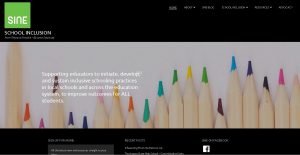
In addition, SINE’s National Convenor, Loren Swancutt has established a new web resource – School Inclusion: From Theory to Practice –  in collaboration with All Means All, aimed at “supporting educators to initiate, develop, and sustain inclusive schooling practices in local schools and across the education system, to improve outcomes for ALL students”, drawing on her experience in inclusive practice and school wide system transformation.

Other benefits of joining SINE

SINE members may access the following benefits:

  • being part of a regular professional forum centered on collaboration;
  • access to information, resources, tips and ideas to support school inclusion;
  • sharing of experiences and insights into best practice, policy, and programs relating to inclusive education; and
  • a safe space to pose questions, and engage in respectful discussions.
[Cover photo © Ian Schneider]

Filed Under: News

Response To Recent Media Reports About Students With Disability

June 4, 2017 by allmeansall Leave a Comment

All Means All

RESPONSE TO RECENT MEDIA REPORTS ABOUT STUDENTS WITH DISABILITY, 4 JUNE 2017

All Means All is the The Australian Alliance for Inclusive Education.  We are a nationwide network of people and organisations working together for the implementation of an inclusive education system and the removal of the legal, structural and attitudinal barriers that limit the rights of some students to access an inclusive education in regular Australian classrooms.

A key part of our work is to ensure that discussion about students with disability is balanced, informed by sound evidence and respectful of their rights.

All Means All is extremely disappointed by recent reports in the media in relation to the education of students with disability, especially reports connected with the current Parliamentary Inquiry in New South Wales.

One of these reports in the Daily Telegraph on 3 June 2017 relied on a few individual cases to make sweeping and unsubstantiated claims that “thousands of children with extreme learning and behaviour problems are seriously affecting the academic performance of other students in schools across the state”.

While it was not even clear that all the examples given involved children with disability, the article asserted, again without substantiation, that “parents, disability groups, educators and schools say there are not enough places in special education settings for problem kids”.

In fact, research has demonstrated the following about special (segregated) education settings in NSW.

  • Enrolments in separate segregated settings are increasing faster than total enrolments in NSW government schools (Sweller, Graham & Van Bergen, 2012).
  • Enrolment growth is being fuelled by enrolments in the behaviour disorder category (Graham & Sweller, 2011).
  • One third of NSW government special schools now cater specifically to students labelled with emotional and behavioural disorders (Graham, 2012).
  • Boys from low-socioeconomic backgrounds and Indigenous students are significantly overrepresented (Graham, 2012) and their overrepresentation is increasing (Sweller, Graham & Van Bergen, 2012).
  • Reintegration to mainstream is rare and enrolments of up to four years are not uncommon (Granite & Graham, 2012).
  • Research has noted high rates of absenteeism, drop-out and graduation to juvenile justice (Graham, Sweller & Van Bergen, 2010).

Calls from mainstream school leaders for students with disability to be placed in segregated settings continue, despite research evidence that:

  • Students with disabilities included in regular education settings outperform their segregated peers socially and academically, have higher rates of attendance, are less likely to have behavioural problems, and are more likely to complete secondary school than students who have not been included.
  • Including students with disabilities in regular education classes does not harm non-disabled students and some academic and social benefits have been found. However, small negative effects on outcomes for non-disabled students may arise where a school ‘concentrates’ students with severe emotional and behavioural disabilities in the one class (itself a form of segregation) rather than distributing the students across classrooms.

It is critical to understand that the issues sought to be highlighted are not, as presented in the article, inherent in the students.  Rather, they reflect poorly on an education system that is not adequately accommodating all its students – particularly students with disability – to realise their legal and human rights to an education alongside and together with their same age peers in regular classrooms as recognised by the Disability Discrimination Act 1992 (Cth) and Article 24 of the UN Convention on the Rights of Persons with Disabilities, to which Australia is a party.

Segregating students with disability through placement in special units and special schools increases the likelihood of those students being trapped on a separate “special” low expectation pathway to a future of social and economic exclusion.

Italy abolished segregated special education in the 1970s. Australia, a significantly more affluent nation, can do much better in 2017. It can start by heeding the call of the United Nations, in its clarification of Article 24, for it to transfer resources from segregated education settings to supporting the inclusive education of students with and without disability.

No one denies that regular schools need more resources to educate the diverse body of learners representing Australian school children or that teachers, education assistants and particularly school leaders need to be upskilled.

However, the answer is not to demonise students with disability – to play or be seen to play the prejudice card – to appeal to lingering fear, stigma and stereotypes about people with disability. The reality is that students with disability are much more likely than their non-disabled peers to be abused, neglected or bullied at school, including bullying by teachers and other school staff (for example, in a 2016 Report by Autistic Family Collective on the experiences of bullying of autistic children, over 40% of participants said bullying was instigated by teachers and other school staff).

It is morally reprehensible, socially destructive and at best disingenuous for school leaders to cast their appeal in the media for more resources by politicising the most marginalised, vulnerable and devalued students in our community – when the target should be the broader system that they administer and that administers them.

As the 2016 Report by the Education and Employment References Committee of the Australian Senate into the impact of policy, funding and culture on students with disability found, negative cultural attitudes and misconceptions amongst school administrators, teachers, parents (including some parents of children with disabilities) present some of the most challenging barriers to access to education for students with disability.  The Report further recognised that “one of the primary drivers of families choosing to enrol their child in a special school is a consequence of … informal gatekeepers at mainstream schools discouraging the enrolment of students with disability”.

The Report recommended the improvement of training and support of principals, teachers and support staff in inclusive education practices and that the Commonwealth government should work with the States to establish a national strategy that recognises all students with disability as learners and to “drive the cultural change required to achieve this, particularly at school leadership level”.

We call on school principals, educators and their unions commenting on this issue in the media to engage in discussions about the education of students with disability, including discussions about funding and resources, in a manner that is constructive and fair, while being respectful of their fundamental rights.

You can visit our website for more information at www.allmeansall.org.au

For media queries contact hello@allmeansall.org.au

Click here to view or print this statement in PDF.

Filed Under: News

We’ve launched!

May 10, 2017 by dev Leave a Comment

We are excited to launch our website, where you can access helpful inclusive education resources and keep up-to-date with the latest news, research and developments!

First, a little bit about us.

All Means All is the Australian Alliance for Inclusive Education, a nationwide network of people and organisations working together to ensure that all Australian students are able to access a quality inclusive education.  We have come together as families, academic experts, teachers, education assistants, Principals, organisations and others who support our mission, working to remove the legal, structural and attitudinal barriers that limit the rights of some Australian students, including students with disability, to access a fully inclusive education in a supported general education environment.

Our objectives include:

  • the creation of resources and the provision of training and education to support inclusive education;
  • supporting, commissioning or undertaking relevant research and study;
  • lobbying for and informing change in legislation and policy to ensure inclusive education as a right for all;
  • consolidating and focusing the Australian movement for full inclusive education to accelerate the necessary systemic and attitudinal change for the benefit of every Australian student;
  • collaborating with relevant community organisations to promote the Australian movement for full inclusive education nationally and internationally; and
  • community education about the value and important of full inclusive education for all Australian students.

If you’re a parent, you may like to join the SIPN School Inclusion Parent Network.  You can find out more about SIPN here.  We are also working to create a similar network for educators.  Please contact us if you are an educator and interested in being part of this initiative.

When we talk about inclusive education we do not mean segregated, self-contained programs or classes for students with disability or learning or behavioural difficulties in schools.

Our work is guided by the principles embodied in the United Nations Convention on the Rights of the Child and the United Nations Convention on the Rights of Persons with Disabilities (UNCRPD).  The UNCRPD is recognised as the most authoritative expression of the human rights of people with disability, including the right to inclusive education under Article 24, as amplified in August  2016 in General Comment No. 4 (Right to Inclusive Education) of the United Nations Committee on the Rights of Persons with Disabilities.

Our resources include a Parent Toolkit and Teacher Toolkit.

If you are interested in joining our network and supporting our work you can contact us.

You can also keep up with us on Facebook and Twitter.

Filed Under: News

SIPN School Inclusion Parent Network

May 5, 2017 by dev Leave a Comment

What is the School Inclusion Parent Network (SIPN)?

SIPN is a Network of All Means All and part of its effort to  foster connections and collaborations within specific stakeholder groups or communities to support the achievement of shared objectives.

SIPN operates at 2 levels:

  1. as a national Network; and
  2. at more local level, through self-sustaining local parent support groups (SIPN Local Groups).

SIPN is led by a National Convenor who guides the focus of the Network, facilitates the provision of quality information and resources, encourages constructive engagement and provides valuable insights to the Board of All Means All to assist in informing its work.

SIPN began as a grass-roots initiative by families committed to building welcoming and inclusive school communities and supporting each other to navigate the school years, ensure that children gain access to the general education classroom, receive the appropriate supports and stay on the path to an inclusive future.

For many parents, staying on an inclusive path can feel daunting and feel isolating.  Stress may be compounded by trying to understand a school environment that may be struggling to include their child.  Some parents say that they just don’t know what “inclusion” of their child should look like – but they don’t feel like their child is being “included” – that things could be better.  The result is often years of constant challenges, disappointment and frustration – at the emotional expense of everyone, and especially the child.

By becoming a member of SIPN’s national Network  you can be part of our inclusive education community, connect with other families for mutual support and join us in promoting inclusive education for ALL!

Benefits of joining SIPN

SIPN members may access the following benefits:

  • being part of a regular forum for peer support, which may help to reduce feelings of isolation for parents encountering challenges in the course of their child’s schooling;
  • gaining more structured access to information, experiences and insights into school inclusion and best practices as well as policy, programs and developments relating to inclusive education;
  • connecting with parents who are more experienced in the schooling journey, to mentor and support less experienced parents;
  • participating in membership events, activities and advisory groups and having voice on our social media forums, consultations and feedback, to inform the work and direction of All Means All.

Setting up you own SIPN Local Group

In addition to membership to the SIPN national Network, some members may wish to establish SIPN Local Groups, at their local school, in a specified area or even State wide.

A SIPN Local Group is really just a local school or local community based way of bringing families together to support each other through their journey to help their child to access an inclusive education experience.

A Local Group can be invaluable by providing additional opportunities for face-to-face contact, for social get-togethers (e.g. a monthly coffee catch up) or group workshops and skills training sessions (e.g. IEP) and presentations (including for the broader school and parental community).  Where a local group operates at school level, it may also provide the school with a two-way parental communication channel on broader matters relating to the inclusion of students with disability and diverse needs.

How a SIPN Local Group is established and how it works will depend upon what families in that group think will work best.  A good starting point is just organising a regular coffee meeting or a wine and cheese night and staying in contact on a closed Facebook Group.  Your school can help the group reach out to interested parents (e.g. through the school newsletter or e-mail database).

Over time for continuity of the group, a more structured approach (e.g. establishing a committee to oversee the group’s activities and any budget) may be better as the children of the organising parents graduate from school.

You can contact us to find out if there is a SIPN Local Group at your child’s school or in your geographical area – but if there isn’t, we would be happy to assist you in starting one.

Filed Under: News

  • « Previous Page
  • 1
  • …
  • 3
  • 4
  • 5
  • 6
  • Next Page »

About Us

All Means All is the Australian Alliance for Inclusive Education, a nationwide multi-stakeholder alliance working together to implement an inclusive education system and remove the legal, structural and attitudinal barriers that limit the rights of some students to access full inclusive education.

Want to learn more

Sign up for all the latest news and resources straight to your inbox.

  • Terms of Use
  • Privacy Policy
  • Copyright
  • Accessibility
  • WordPress Site by Meta Creative