Australian Alliance for Inclusive Education

  • Home
  • Contact Us

Australian alliance for inclusive education

  • About Us
    • Who We Are
    • Meet Our Team
    • Our Networks
    • Expertise and Advice
  • For Parents
    • Toolkit
    • SIPN
    • Parent Resources
  • For Educators
    • Toolkit
    • SINE
    • Educator Resources
  • Latest
  • EduBlog

Committee on the Rights of Persons with Disabilities releases Concluding Observations – Australia

September 24, 2019 by allmeansall Leave a Comment

24 September 2019

The Committee on the Rights of Persons with Disabilities today released its Concluding observations on the combined second and third reports of Australia (Advance Unedited Version) (CRPD/C/AUS/CO/2-3) (2019 Concluding Observations), which it adopted on Friday 20 September 2019, in relation to the Committee’s review of the combined second and third periodic report of Australia (Australia Report) on the implementation of its international human rights obligations under the Convention on the Rights of Persons with Disabilities (CRPD).

The review of Australia, undertaken during the Committee’s 22nd Session in Geneva earlier this month approximately five years after the 2013 initial review of Australia, was attended by:

  • an Australian Government delegation led by Mr Andrew Walter;
  • Dr Ben Gauntlett, Disability Discrimination Commissioner, Australian Human Rights Commission, Australia’s “A” rated National Human Rights Institution; and
  • civil society representatives, including a delegation of 7 Australians with disabilities that included Aboriginal and Torres Strait Islander people with disabilities and people with intellectual disabilities, and representatives from All Means All – The Australian Alliance for Inclusive Education.

All Means All, which had made a Submission to the review in July 2019, was able to meet with several members of the Committee and the office of the UN Special Rapporteur on the Rights of Persons With Disabilities, to discuss the human rights of people with disabilities to inclusive education and the significant evidence of serious systemic failures and substantive non-compliance by Australian governments, with Article 24 of the CRPD.

Similar concerns about inclusive education were also expressed in the Civil Society Shadow Report and the National Human Rights Institution Report submitted by the Australian Human Rights Commission, and highlighted in the statements made by Dr Ben Gauntlett during the constructive dialogues held on 12 and 13 September 2019 (Constructive Dialogues).  In his opening statement at the Constructive Dialogues, Dr Gauntlett noted that “Australia has a segregated education system, where schools have turned away students because of their disability, and the rate and extent of segregation is growing, which is contrary to Article 24 and General Comment No.4.” You can read Dr Gauntlett’s full statement here.

The Committee’s Concluding Observations, which relate to the 35 key issues identified by the Committee in its “List of Issues Prior to Reporting” and sought to be addressed in the Australia Report, recognised some positive aspects, including the introduction of the NDIS and the establishment of the Royal Commission into Violence Abuse, Neglect and Exploitation of People With Disabilities, but expressed serious concerns about a range of issues and strongly criticised, among other things, current legal and policy frameworks and the general failure of Australia to harmonize domestic legislation with the CRPD.  

The Committee also recommended that the Australian Government establish formal and permanent mechanisms to ensure the full and effective participation of people with disabilities, including children with disabilities, through their representative organizations, in the development and implementation of legislation and policies to implement the CRPD.  

In relation to inclusive education, and in comparison with the 2013 Concluding Observations (CRPD/C/AUS/CO/1) of the Committee on Australia’s initial report, the Committee’s comments during the Constructive Dialogues and its 2019 Concluding Observations in relation to Article 24, clearly reveal the Committee’s increased concerns with Australia’s failure to progress inclusive education and alarming growth of segregation of students with disabilities contrary to Article 24 and General Comment No.4.

Notably, this time around, the Committee has provided more specific recommendations (at paragraph 46 of the 2019 Concluding Observations), including the following, which the Committee expressly stated should be read in line with the Committee’s 2016 General Comment No. 4 (the Right to Inclusive Education) and targets 4.5 and 4.a of the Sustainable Development Goals:

  • that Australia develop a national Action Plan for Inclusive Education;
  • that Australia address the increasing rate of segregation, seclusion and isolation of students with disabilities in education;
  • that Australia redirect adequate resources to a nationwide inclusive education system for all students; and
  • that Australia improve the collection of data on the numbers of students with disabilities, including data about “students who do not qualify for an adjustment, are unable to enrol in local mainstream schools, educational attainment and completion, suspension and expulsion rates and the use of restrictive practices and bullying”.

The Committee also called for an end to the practice of detaining and restraining students with disabilities (paragraph 28(e) of the 2019 Concluding Observations).

The Committee’s concerns in relation to the implementation of Article 24 and inclusive education were also evident in statements made during the Constructive Dialogues.  In this regard, Committee Chairperson Mr Danlami Umaru Basharu (at 1.31.34 of the UN webcast Consideration of Australia (Cont’d) – 500th Meeting 22nd Session Committee on Rights of Persons with Disabilities – 13 September) specifically questioned Australia about “reforming the Australian legal and policy framework, including the [Disability Discrimination Act] 1992, to ensure that the rights of students with disabilities to inclusive education are upheld, and there is immediate and progressive implementation of Article 24 and General Comment No.4, including specific measures to address cultural and attitudinal barriers within education departments and at school administration levels and ensure adequate training of and support to school administrators and educators, for the inclusion of students with disabilities.”

Committee Member and law Professor, Dr Markus Schefer noted that “in education, the trend of inclusion seems to be in decline” in Australia (at 0.44 minutes of the UN webcast Consideration of Australia – 499th Meeting 22nd Session Committee on Rights of Persons with Disabilities – 12 Sep 2019) and that “the Melbourne Declaration on Education Goals for Young Australians does not explicitly identify students with disabilities as a priority, and it does not commit explicitly to inclusive education” (at 1.36 of the of the UN webcast Consideration of Australia (Cont’d) – 500th Meeting 22nd Session Committee on Rights of Persons with Disabilities – 13 September).  He also asked “is [Australia] proposing to address these issues within the Melbourne Declaration or within any other framework?”.  Importantly, Dr Schefer took specific issue with the Australian Government’s “views on what ‘inclusive education’ means and that it can involve choice of the parents of segregated education” and stated that “this view stands in stark contrast to what this Committee has consistently defined ‘inclusive education’ to mean”.

Country Rapporteur for the review of the Australia Report, Mr Monthian Buntan, in his final statement at the conclusion of the Constructive Dialogues (at 2.41 of the UN webcast Consideration of Australia (Cont’d) – 500th Meeting 22nd Session Committee on Rights of Persons with Disabilities – 13 September), further stated that the Commitee is “very deeply concerned at the lack of legally enforceable instruments to enforce several issues such as accessibility, inclusive education, employment”.

More broadly, long-standing Committee Member Mr Martin Babu Mwesigwa who participated in and recalled the 2013 review of Australia noted (at 2.42 of the UN webcast Consideration of Australia – 499th Meeting 22nd Session Committee on Rights of Persons with Disabilities – 12 Sep 2019) in reference to the Australia Report, “the information implies that substantially not much has changed in Australia since the review of the initial report in 2013” and that “many of the issues raised in 2013 and communicated in the then Concluding Observations, are the same issues that civil society has brought to our attention 6 years later in 2019.” Mr Mwesigwa then asked “What, in the opinion of the delegation of Australia, have been the reasons for failure to address most of the issues raised in 2013, that formed the then Concluding Observations, over the last 6 years?”

All Means All welcomes the 2019 Concluding Observations and the strong guidance provided to Australia on the human rights of people with disabilities and the need to discharge its international law obligations by implementing the CRPD, including notably Article 24 on the fundamental human right of all students with disabilities to inclusive education.
 

Filed Under: News

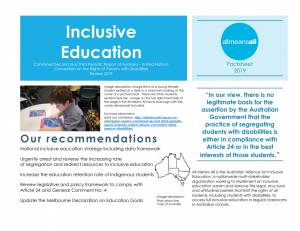
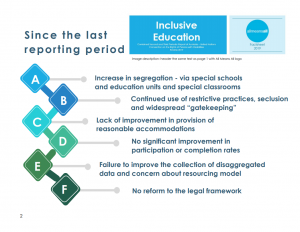
Our Inclusive Education Fact Sheet – UN Review of Australia 2019

August 22, 2019 by allmeansall Leave a Comment

All Means All has prepared a Fact Sheet on Inclusive Education for the United Nations Review of the Combined Second and Third Periodic Report of Australia – Convention on the Rights of Persons with Disabilities.  It is based on our submission to this process, which you can read here.

The review is taking place in September during the 22nd Session of the Committee and will be attended by delegates from Australia including All Means All.

You can view and print the Fact Sheet in accessible PDF here.

Filed Under: News, Uncategorized

Queensland Education Minister’s funding initiatives in direct conflict with Government’s Inclusive Education Policy

August 2, 2019 by allmeansall Leave a Comment

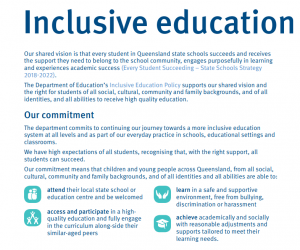
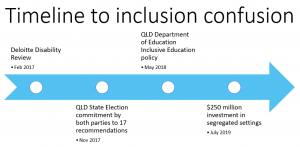
The Inclusive Education Policy for Queensland’s public schools (Queensland Policy) adopted by the Queensland Education Department following the review of education for students with disability in Queensland State schools by Deloitte Access Economics (2017) (Deloite Review), commits the Department to “continuing our journey towards a more inclusive education system at all levels” guided by the applicable international human rights principles.  The Queensland Policy has been welcomed as a strong step in the right direction and a genuine effort to improve outcomes for students with disabilities and address the key criticisms and recommendations of the Deloitte Review.

Assistant Director General Deborah Dunstone (Disability and Inclusion Branch) who described it as “probably the best work I’ve done in my career” at a QUT education event in 2018 (watch video  here), emphasised that in developing the Queensland Policy, “having to define [inclusive education] and be really clear about it from a system point of view was critical”.

Consistently with General Comment No. 4 (2016) to Article 24 of the Convention on the Rights of Persons With Disabilities (UN CRPD) which was ratified by Australia in 2008, and Sustainable Development Goal No. 4 in the 2030 Agenda, the new Policy provides:

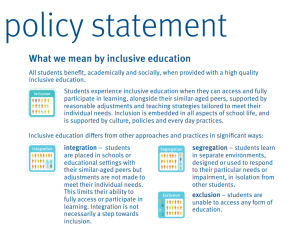
“Inclusive education means that students can access and fully participate in learning, along-side their similar-aged peers, supported by reasonable adjustments and teaching strategies tailored to meet their individual needs.  …

Inclusive education differs from the following approaches and practices in significant ways:

…

Segregation – students learn in separate environments, designed or used to respond to their particular needs or impairment, in isolation from other students.”

General Comment No. 4, which provides the most authoritative guidance to governments on their obligations to students with disabilities under international human rights law, further states that:

  • “The right to non-discrimination includes the right not to be segregated and to be provided with reasonable accommodation” [para 13];
  • Progressive realization means that State parties have a specific and continuing obligation “to move as expeditiously and effectively as possible” towards the full realization of article 24.  This is not compatible with sustaining two systems of education: mainstream and special/segregated education systems.”  [para 39]; and
  • “The [UN CRPD] Committee urges State parties [including Australia] to achieve a transfer of resources from segregated to inclusive environments.” [para 68]

However, less than a year after the Queensland Policy’s launch and months after the Queensland Government’s commitment to a human rights approach through the passage of the Human Rights Act 2019, Grace Grace, the Minister appointed to the Education portfolio in the second term of the Palaszczuk Government, has announced in Parliament new budgetary allocations that deliberately preference segregated education of students with disabilities and has praised an increase in segregated settings for students with disabilities.  This not only runs counter to the Queensland Government’s policy commitment, but also breaches the principle of “progressive realisation” of UN CRPD Article 24 General Comment No. 4 and further represents an impermissible deliberate retrogressive measure that must be immediately addressed.

At a Budget Estimates Committee hearing on 1 August 2019, the Minister stated as follows.

“Ms GRACE: The Palaszczuk government has a proven track record of supporting school students with a disability. I am proud that this budget continues that support. The budget includes a four-year $136.2 million funding boost to provide additional teachers and teacher aides in state school special education services across Queensland. The number of students with a disability enrolled in Queensland schools is growing.

I remember opening a new school extension—a beautiful new building—on the Sunshine Coast. One family there came from northern New South Wales. They had moved to Queensland and they said that the provision of education for their daughter at that special school on the Sunshine Coast was second to none and absolutely amazing. They were beaming about the manner in which their daughter was growing because of the education our special schools deliver every single day. I take my hat off to those teachers and teacher aides who work in this area and do a wonderful job. That is one example of many.

We are investing in facilities in special schools. The quality of education is fantastic. We are looking forward to employing an additional 150 teachers and 90 teacher aides next year alone in order to give our students the special support they need.

The numbers are increasing greater than in the mainstream. We will have a four per cent increase over the next five years compared with around 1.5 per cent in the mainstream. There is a growth in that area.

The budget includes facilities such as a new special school to open in 2021 at Palmview on the Sunshine Coast and completion of construction of a new secondary special school at Caboolture, opening in term 1 of 2020. I was very proud to visit with the local member, Minister Mark Ryan, a couple of weeks ago to see the progress of that school. It will be state-of-the-art for its students. The school will welcome up to 160 year 7 to 12 students in term 1 of 2020. It will be a game changer for the Caboolture community. Well done there.”

All Means All has been concerned for some time that, unlike her predecessor Kate Jones who oversaw the Deloitte Review and the development of the Queensland Policy, this Education Minister does not appear to understand  or support her own Government’s policy setting, which she has rarely acknowledged since her appointment to the role.  Indeed, to be proud of increased investment in segregated education and the “quality” of segregated education in Queensland as “fantastic”, evidences a failure to recognise not only the direction in the Queensland Policy but the clear statements by the UN that segregation of children with disabilities is a human rights issue and constitutes discrimination against them.

The Minister’s position also flies in the face of over 40 years of research that strongly and consistently evidences that segregated education is not beneficial – or safe – for students with disabilities.  Indeed, the national Royal Commission into Institutional Responses to Child Sexual Abuse recognised in its Final Report in 2017, and in the research it commissioned, that segregation, including in education, is a ‘setting-based risk factor’ that heightens risk of abuse of children with disabilities.

The issue of the increase in segregation of Australian students with disabilities is expected to be examined by the UN later this year during its review of Australia’s report on compliance with the UN CRPD.  The issue was also raised by the UN Committee on Economic, Social and Cultural Rights in the course of its 2017 consideration of the fifth periodic report of Australia on its implementation of the International Covenant on Economic, Social and Cultural Rights, when it asked Australia to explain “evidence of a rise in segregated education’ and recommended in its Concluding Observations that Australia take “effective steps to ensure that children with disabilities, including those with cognitive impairments, can access inclusive education”.

It is also deeply disappointing that the Minister has sought to perpetuate the myth that parents of children with disabilities want their children to be segregated, without acknowledging the “gatekeeping” and other systemic failures that drive them out of the general education system in the first place, including because of budgetary allocations that preference segregation.

As noted by delegates during the sessions for the drafting of Article 24 of the UN CRPD in rejecting segregated “parallel” models of education, “segregated education is in fact a false choice enforced by lack of resources and access to support”.

We call on Minister Grace and Premier Palaszczuk to confirm their support for Queensland’s Inclusive Education Policy, and encourage the Queensland Government to move as expeditiously and effectively as possible to transfer resources from segregated to inclusive environments as is required of governments bound by the UN CRPD.

Filed Under: News, Uncategorized

Our UN Submission – Review of Australia – Convention on the Rights of Persons with Disabilities

July 25, 2019 by allmeansall Leave a Comment

All Means All

Submission

Combined Second and Third Periodic Report of Australia – United Nations Convention on the Rights of Persons with Disabilities

26 July 2019

All Means All – The Australian Alliance for Inclusive Education

Endorsed by Disabled People’s Organisations Australia (DPOA), Children and Young People With Disability Australia (CYDA) and Inclusion International.


Click the PDF icon to READ and PRINT.  


Also available in PLAIN ENGLISH format. 

Filed Under: News, Uncategorized

New journal article: A CRPD analysis of NSW’s policy on the education of students with disabilities – A retrogressive measure that must be halted

June 12, 2019 by allmeansall Leave a Comment

Coming after recent media attention on the increasing segregation in NSW of “gifted” students based on selective academic streaming, the Australian Journal of Human Rights (produced by the Australian Human Rights Centre  at the University of NSW) has published an article that critically analyses recent policy developments in NSW that will increase the segregation of students with disabilities.

NSW, perhaps more than any other state of Australia, is presiding over an increasingly vertically stratified and segregated education system based upon “intellectual” expectations  and implicit prejudice.

The article concludes that the growing segregation of students with disabilities in NSW amounts to a significant breach of their fundamental human right to an inclusive education under international human rights law.  Further, it provides much-needed analysis of relevant legislation and government policy in light of Australia’s legal obligations under the United Nations Convention on the Rights of Persons with Disabilities (CRPD), which was ratified by Australia in 2008.

The authors, Emily Cukalevski (from the Centre for Disability Law and Policy, National University of Ireland, Galway and a former associate to the United Nations Special Rapporteur on the Rights of Persons with Disabilities) and Catia Malaquias (a lawyer and co-founder of All Means All), analysed Article 24 of the CRPD, especially in light of the CRPD Committee’s guidance in General Comment No.4 and General Comment No.6.

They specifically considered the meaning of “inclusive education” and noted that special schools, special units co-located in mainstream school grounds and special classes in mainstream schools are each forms of “segregation” that are incompatible with inclusive education.  General Comment No.4 defines “segregation” as the provision of education to students with disabilities “in separate environments designed or used to respond to a particular impairment or to various impairments, in isolation from students without disabilities”. They authors further consider the implications of the CRPD Committee’s guidance that segregation is disability-specific discrimination and the right to non-discrimination includes the right not to be segregated.

The authors also critically analysed the development of the NSW Government’s policy position and its genesis in a recent report of the NSW Parliament into the education of students with disabilities. Despite the report’s overall intent seemingly being in line with the core purpose of Article 24, it established a flawed foundation for NSW’s policy as it misconceived inclusive education and consequently concluded that segregated settings and a policy of inclusion are not “mutually exclusive ideals”.  Unfortunately, as the authors have identified, this conclusion is inconsistent with the report’s own definition of inclusive education, as well as the CRPD’s guidance.

The authors have concluded that the NSW Government’s current policy, and in particular its commitment to increase “support class establishments … at a greater rate than general enrolment growth”, not only contravenes Article 24 but also amounts to deliberate and impermissible retrogression under the CRPD:

“[T]he plan to increase segregated support classes is an unjustified retrogressive measure. It is a deliberate policy decision that is designed to reverse the progress made towards realising an inclusive education system in NSW. It directly targets learners with disabilities and diverts funding and resources away from inclusive education measures; where funds could be used to support students with disabilities in regular classes, they will now be deployed to deliver a greater level of segregated education to those students in support classes. This decision has not been justified on the basis of limited resources or an economic crisis and it is not intended to be temporary. Rather, it has been justified on a misconception of inclusive education itself and on a skewed understanding of student ‘needs’.”

The article also notes that while a decade has passed since ratification of the CRPD, Australia does not have an overarching national inclusive education strategy.  The Australian Government is obliged to ensure that Article 24 is implemented without limitations or exceptions in all parts of the country.  The absence of a national commitment to inclusive education has contributed to compromising and delaying the realisation of the human rights of Australian students with disabilities across Australia’s States and Territories:

“The lack of a strong national framework has provided space for the NSW Government to commit to measures that are not only inconsistent with Article 24 but also amount to an impermissible retrogression under the CRPD. It has also led to concerning jurisdictional divergences.”

The authors end with a call for the Australian Government to drive the systemic and cultural change that is required to realise inclusive education consistently across Australia – through the adoption of stronger national discrimination legislation and the provision of guidance and coordinated policy reform (including a national inclusive education strategy) – to ensure that all schools can become beacons in their communities for the inclusion of people with disabilities.

You can download the published article here (download fee may apply).  Alternatively you can view the authors’ manuscript here.

Filed Under: News, Uncategorized

Abuse of students with disabilities must stop! Response to A Current Affair story

February 27, 2019 by allmeansall Leave a Comment


All Means All

27 February 2019

All Means All – The Australian Alliance for Inclusive Education is saddened but not surprised that yet another story of abuse of students with disabilities has come to light, in this case involving serious allegations of physical and verbal abuse of a 5 year-old student with Down syndrome in a segregated special unit co-located with a mainstream government school in New South Wales.  Unfortunately, we know from our work with families that for many students with disabilities, abuse in our schools is a pervasive and devastating reality.

The story which aired on Channel 9’s “A Current Affair” program today, included audio recordings taken by the child’s parents after they suspected physical abuse but had their concerns dismissed.  We understand that they decided to approach the media after contacting the NSW Department of Education and feeling dissatisfied with the response and desperately concerned for their child.

“Students with disabilities, including the young student featured in the A Current Affair report, have the right to be safe from harm at school and to access a fully inclusive education in regular classrooms with their non-disabled peers, in the general education system.” said All Means All Chairperson, Gina Wilson-Burns.

While we know that entrenched prejudice, devaluation and ableist attitudes means that all students with disabilities across all educational settings are at increased risk of violence, abuse and neglect, we also know that segregation of students with disabilities, particularly intellectual disabilities, into separate classrooms and settings is a factor that materially heightens this risk.

This was identified in the Final Report of the Royal Commission into Institutional Responses to Child Sexual Abuse and in its published research, “Disability and child sexual abuse in institutional contexts”, which concluded that “[s]egregation and exclusion in closed institutional contexts away from public scrutiny leaves children (and adults) with disability at heightened risk of violence and harm including sexual abuse”, and noted the reduced oversight within segregated settings and the reduced capacity of children with cognitive disabilities to share concerns about abuse and neglect.

The right not to be segregated –  whether in special classes or units in mainstream schools or in special schools – and to access a quality inclusive education is encompassed in Article 24 of the  Convention on the Rights of Persons with Disabilities, to which Australia is a party.

A range of international human rights instruments including General Comment No. 4 (The Right to Inclusive Education) have made it clear that the segregation of students with disabilities  is a form of discrimination against them and that it is not compatible with their right to inclusive education under Article 24. For example paragraph 13 of General Comment No.4 states that “the right to non-discrimination includes the right not to be segregated and to be provided with reasonable accommodation”.

Research evidence over the last 40 years has also consistently found that students with disabilities benefit academically and socially from education in regular classrooms in the general education system. A 2008 review of comparative research found that “[n]o review could be found comparing segregation and inclusion that came out in favour of segregation in over forty years of research”. A  2017 comprehensive review of the research comprising 280 studies from 25 countries also found that inclusive education produced superior social and academic outcomes for all students and that academic and social outcomes for children in fully inclusive settings are without exception better than in segregated or partially segregated environments (e.g. special support units or classrooms).

“It’s time for governments across Australia to denounce the myth that ‘special’ segregated settings keep students with disabilities safe and are in their best interests, and to commit to real reform so that children with disabilities can be safe and fully included within the general education system. Safety comes with being valued, known and connected and that starts with being in the same classroom as all the other children.” said Ms Wilson Burns

All Means All calls on the Australian government to:

  • immediately institute the announced Royal Commission into violence, abuse and neglect against people with disabilities, extending to the treatment of students with disabilities in our schools, across all settings; and
  • unequivocally commit to systemic reform to implement a universally accessible, quality and fully inclusive education system in accordance with its international human rights obligations.

We also call on the NSW government to commit to genuine inclusive education reform, including by abandoning its policy decision to increase segregated support classes for students with disabilities as outlined in its response to the report of the NSW Legislative Council Portfolio Committee No.3 into “Education of students with a disability or special needs in New South Wales”:

“Support class establishments will increase in 2018 at a greater rate than general enrolment growth, consistent with trends in recent years.  The trend since 2012 is for the majority of new support classes to be established in mainstream schools.”

Increasing the segregation of students with disabilities – whether in separate classrooms in mainstream schools or other segregated settings – will not achieve an inclusive education system.

The answer lies in genuine systemic reform that begins with resource-allocation driven change, guided by a national inclusive education strategy.

We hope that the young student in the A Current Affair story and her family will overcome this traumatic experience, and that they receive the support they need to ensure their child can be safe at school and access a genuinely inclusive education experience, to which she is entitled.

All Means All – The Australian Alliance for Inclusive Education is a multi-stakeholder alliance working for the implementation of an inclusive education system and the removal of the legal, structural and attitudinal barriers that limit the rights of some students, including students with disabilities, to access an inclusive education in regular Australian classrooms.

You can visit our website for more information at www.allmeansall.org.au

For media queries contact hello@allmeansall.org.au

Filed Under: News, Uncategorized

Our Submission – Queensland Human Rights Bill 2018 – Right to Education

November 26, 2018 by allmeansall Leave a Comment

All Means All

Submission

Human Rights Bill 2018 (Queensland)

Section 36 – Right to Education

26 November 2018

 All Means All – The Australian Alliance for Inclusive Education

View or download PDF Submission here.

Introduction

  1. All Means All is the Australian Alliance for Inclusive Education, a nationwide multi-stakeholder organisation working together to implement an inclusive education system and remove the legal, structural and attitudinal barriers that limit the rights of all students, including students with disabilities, to access full inclusive education in regular classrooms in Australian schools.
  2. All Means All’s stakeholders include children, families, educators and academic experts in Queensland and around Australia.
  3. All Means All congratulates the Government of Queensland on the introduction of the Human Rights Bill 2018 (the Bill) and thanks the Parliament of Queensland for the opportunity to make this submission.
  4. This submission has been approved pursuant to board policy of All Means All.
  5. It primarily considers the proposal by the Queensland government to protect the fundamental human right to education through proposed Section 36 of the Bill.
  6. While we strongly support the express recognition of the human right to education in the Bill, in our view the proposed terms of Section 36 are insufficient and inappropriate and their application is likely to lead to perverse outcomes in violation of the human right to education for persons with disabilities.
  7. In this regard, Section 36 of the Bill does not reflect the expression of the right to education as set out in relevant international treaties ratified by Australia, including Article 13 of the International Covenant on Economic, Social and Cultural Rights (ICESCR), which is purported to be the source of the human right to education in Section 36 of the Bill (see Explanatory Note for the Bill).
  8. Further, key elements of the right to education recognised and clarified in other relevant Conventions, namely the Convention on the Rights of the Child (CRC), and the Convention on the Rights of Persons with Disabilities (CRPD) aimed at ensuring the realisation of the right to education for vulnerable groups, including students with disabilities, have not been reflected in Section 36 of the Bill.
  9. Finally, we believe that the proposed wording in Section 36 (1) and (2) may have the unintended consequences of increasing discrimination in education against persons with disabilities, including in breach of the Commonwealth’s Disability Discrimination Act1992 (DDA), undermining the realisation of their right to education and leading to serious human rights violations.
  10. Our detailed analysis is set out below.
  11. In examining the relevant treaty texts and works of the treaty bodies, we have applied the rules of interpretation codified in the Vienna Convention on the Law of Treaties.

Recommendations

  1. Recommendation 1:That proposed Section 36 of the Bill be replaced with the following provision reflecting the intent of applicable international Conventions and domestic disability discrimination laws:

Right to education

(1)  Every person has the right to education without discrimination and on the basis of equality of opportunity.

(2)  To realise this right, every person has the right to access quality early childhood, primary and secondary school education, and further education and training that is accessible and inclusive of all.

  1. Recommendation 2: That the Bill include a stand alone cause of action so that breaches of human rights can be heard before QCAT or the Supreme Court,
  2. Recommendation 3: That the Bill ensure that people have access to an effective remedy, including by compensating them.

Overview of human right to education in international human rights law

  1. The right to education has been recognised in a range of international human rights instruments applicable to Australia and its expression has evolved in the 70 years since the Universal Declaration of Human Rights, adopted in 1948, first stated the universality of the right in Article 26:

‘Everyone has the right to education’

  1. Subsequent international treaties have reaffirmed the right to education generally [1], with thematic treaties also addressing the right to education in relation to specific groups [2].
  2. The right to education was first made into a binding international legal obligation by the ICESCR, which entered into force in 1976 and recognises that everyone has the right to education directed towards the full development of the human personality and its sense of dignity, and to strengthening respect for human rights and fundamental freedoms. Article 13(1) provides:

“The States Parties to the present Covenant recognize the right of everyone to education. They agree that education shall be directed to the full development of the human personality and the sense of its dignity, and shall strengthen the respect for human rights and fundamental freedoms. They further agree that education shall enable all persons to participate effectively in a free society, promote understanding, tolerance and friendship among all nations and all racial, ethnic or religious groups, and further the activities of the United Nations for the maintenance of peace.”

  1. Article 13(2) of ICESCR provides some guidance on the realisation of the right to education and calls, among other things, for the provision of primary education that is “compulsory and available free toall” and for secondary education to be“made generally available and accessible to all by every appropriate means, and in particular by the progressive introduction of free education”.
  2. The Committee on Economic, Social and Cultural Rights (CESCR) further explains the right to education in its General Comment No.13. Notably, paragraph 6 of General Comment No.13 states that education should be available, accessible, acceptable, and adaptable. These concepts are explained to encompass the accessibility of education to all learners, its provision on the basis of non-discrimination and its acceptability in form, content, curricula, and overall substance. Further, education has to maintain adaptability to adjust to the changing and diverse needs of students; because education is a right, it must adapt to the learning needs of students – not the reverse.
  3. While education is considered a cultural right, it is also related to many other human rights because the enjoyment and realisation of other rights is dependent on realisation of the right to education [3]. This relationship between the right to education and other rights illustrates the indivisibility and interdependence of all human rights:

“As an empowerment right, education is the primary vehicle by which economically and socially marginalized adults and children can … obtain the means to participate fully in their communities.” [4]

  1. Articles 28 and 29 of the CRC, which entered into force in 1989, reflect the ICESCR principles primarily through the concepts of “equal opportunity” (Article 28(1)), “accessibility” (Article 28(1)(a), (b) and (c)) and more broadly “non-discrimination” (Article 2). Further, the CRC is the first international human rights treaty to include disability as a prohibited ground for discrimination (Article 2) and to explicitly recognise education for children with disabilities (Article 23).
  2. Article 24 of the CRPD, which came into force 17 years after the CRC in 2006, provides the most up-to-date expression of the right to education and the fundamental principles that underpin it, such as “equality of opportunity” and “non-discrimination” and “accessibility”. It is also the first international treaty to expressly recognise that inclusive education is the means by which persons with disabilities realise their right to education, and to impose a legal obligation on State parties to ensure an inclusive education system at all levels, with a correspondent right to inclusive education.
  3. Article 24.1 of the CRPD provides as follows:

“States Parties recognize the right of persons with disabilities to education. With a view to realizing this right without discriminationand on the basis of equal opportunity, States Parties shall ensure an inclusive education systemat all levels and lifelong learning directed to:

(a)  The full development of human potential and sense of dignity and self-worth, and the strengthening of respect for human rights, fundamental freedoms and human diversity;

(b)  The development by persons with disabilities of their personality, talents and creativity, as well as their mental and physical abilities, to their fullest potential;

(c)  Enabling persons with disabilities to participate effectively in a free society.” 

  1. Article 24.2 of the CRPD requires that “reasonable accommodation of the individual’s requirements is provided” and that “persons with disabilities receive the support required, within the general education system, to facilitate their effective education”.
  2. It is worth noting that the Queensland Government’s newly released “Inclusive Education Policy”adopts key concepts from General Comment No.4 (Right to Inclusive Education), the guidance text issued by the Committee on the Rights of Persons With Disabilities (CRPD Committee) explaining the requirements of Article 24.
  3. In our view and consistently with the fundamental principles underlying the expression of the universal human right to education under international human rights law applicable to Australia, Section 36 of the Bill should incorporate the concepts of freedom from discrimination, equality of opportunity, accessibility andinclusive education. In this regard, section 22 of the DDA prohibits discrimination on the grounds of disability in the context of education.
  4. The proposed qualification in Section 36 of the Bill to education being “appropriate to the child’s needs” is not present in the expression of the right to education under the applicable human rights instruments, whether generally or in the context of specific groups or themes.
  5. Our strong concern is that this language is likely to encourage discrimination against students with disabilities in particular, and undermine the realisation of their human right to inclusive education. In our view, it is not appropriate to adopt this language in Section 36 of the Bill as there is nothing in Article 13 of ICESCR or beyond, that supports its use.
  6. While we cannot be certain of the source of the term “appropriate to the child’s needs” and the wording in Section 36 of the Bill in general, we are concerned that this is intended to reflect the concept of “free and appropriate public education” (FAPE) under the domestic law of the United States of America, adopted by Section 504 of the 1973 Rehabilitation Act, Individuals with Disabilities Education Act and Americans with Disabilities Act.
  7. It is worth noting that unlike Australia, the United States of America has never ratified the CRC or the CRPD and its domestic laws do not seek to adopt those treaties as part of its legal framework for education. 

“Appropriate to the child’s needs” undermines right to inclusive education

  1. We believe that the adoption of the term “appropriate to the child’s needs” in Section 36 of the Bill is likely to:

(a)  perpetuate discriminatory treatment and inequality based upon the segregation of students with disabilities; and

(b)  “justify” explicit and implicit prejudice in educational administration in qualifying the concepts of “non-discrimination”, “full participation” and “equality of opportunity”,

and thereby has great potential to undermine the right of children, particularly children with disabilities to education, which is to be understood as at right to inclusive education in regular (non-segregated) settings (see Article 24 of the CRPD and General Comment No. 4 – Right to Inclusive Education) [5].

  1. We note that following the public release of the Bill, we were contacted by many parents of children with disabilities in Queensland expressing serious concerns about the terms of Section 36 and the words “appropriate to the child’s needs” and urging us to make a submission to this process. Some of the comments we received were:

“’Appropriate to your child’s needs’ is just another way we are told that they don’t want to meet our son’s needs in mainstream and that our son should be somewhere more ‘appropriate’ – in special school.”

“These are the words that people use against our children, to exclude them from mainstream.”

“We fought for a good Inclusive Education Policy and the government delivered it. These words go against that, some people will argue it gives them a right to segregate children.”

“If you don’t know how these words have been used to keep children with disabilities out of mainstream education then you don’t see the problem.”

“Our children have the right to be included and they have human rights. Let’s protect that by using the right words instead.” 

“My child’s needs are your child’s needs. All children have the same fundamental human needs but those needs may be met in different ways for different kids because we all diverse.  This is about making education that is accessible to everyone, so why aren’t we using the right words to say this?”

“Why are we even using American education laws for human rights?!! They haven’t even signed the human rights Conventions and they have huge problem of inequality. Thanks but no thanks.”

“My son has finished school now but speaking from experience, these words ‘appropriate to your child’s needs’ have never been our friends.” 

  1. In particular, the denial to children with disabilities of their right to access general education and their placement in segregated educational settings is recognised by the CRPD Committee as a clear form of discrimination in education[6], one it has urged States Parties to immediately address in its anti-discrimination legislation.
  2. This same concern was recognised by the CESCR on 31 May of 2017 in consideration of the fifth periodic report of Australia on its implementation of Article 13 of the ICESCR:

“Rodrigo Uprimny, Committee Expert and Co-Rapporteur for Australia: “As for persons with disabilities and inclusive education, there was evidence of a rise in segregated education. What measures was the Government taking to ensure inclusive education across the country? [7]”

  1. Children with disabilities are a significantly marginalised group and despite the recognition of their fundamental human rights to education, including the right to inclusive education in the last decade, they continue to experience serious violations of their fundamental, consequent and associated human rights.
  2. The reality of the experience for too many children with disabilities across Australia is that the education system remains resistant, both culturally and in terms of educational practice, to accommodating their full and effective participation and inclusion, particularly for students with intellectual, cognitive or sensory disabilities and for autistic students. This experience is due to discrimination and devaluation, isolation, lack of resources and supports and inflexible structures and approaches that operate as barriers for students with disabilities realising their right to inclusive education.
  3. The proposed wording of “appropriate to their needs” in Section 36 of the Bill threatens to provide a qualification on the human right to education and thereby a justification for the adverse educational experiences of many Australian children, including in Queensland, and a basis for the persistence and growth of segregated settings.
  4. These concerns are backed up by many Parliamentary and departmental inquiries across Australia, notably the 2017 review of education for students with disability in Queensland State schools by Deloitte Access Economics and the national 2016 Report by the Education and Employment References Committee of the Australian Senate into the impact of policy, funding and culture on students with disabilities.

Other issues

  1. The specific wording “based on the person’s abilities” in sub-section (2) is also likely to lead to discriminatory outcomes for persons with disabilities potentially in breach of the DDA. Rather, access to further education should be guaranteed on the basis of equality of opportunity, without discrimination.
  2. We also find the reference to “vocational”, as opposed to “further” education and training, to be outdated and inappropriate.

_________________________________________

[1] International Covenant on the Elimination of All Forms of Racial Discrimination (1965); International Covenant on Economic Social and Cultural Rights (1966).

[2] See Convention on the Elimination of All Forms of Discrimination against Women (1979); Convention on the Rights of the Child (1989); International Convention on the Protection of the Rights of All Migrant Workers and Members of their families (1990); Convention on the Rights of Persons with Disabilities (2006).

[3] United Nations General Assembly, Human Rights Council Annual report of the United Nations High Commission for Human Rights and reports of the Office of the High Commission and the Secretary-General. Thematic study on the right of persons with disabilities to education. A/HRC/25/29 (18 December 2013), para. 9

[4] Ibid.

[5] CRPD/C/GC/4, see https://tbinternet.ohchr.org/_layouts/treatybodyexternal/Download.aspx?symbolno=CRPD/C/GC/4&Lang=en

[6] Ibid, paragraphs 10, 12, 13 and 39. See also CRPD/C/GC/6 paragraph 64.

[7] See http://www.ohchr.org/EN/NewsEvents/Pages/DisplayNews.aspx?NewsID=21677&LangID=E

Filed Under: News, Uncategorized

Our Submission to UN Human Rights Council – Empowering children with disabilities for the enjoyment of their human rights, including through inclusive education

October 16, 2018 by allmeansall Leave a Comment

All Means All

Submission

United Nations Human Rights Council resolution 37/20

Empowering children with disabilities for the enjoyment of their human rights, including through inclusive education

10 October 2018

 All Means All – The Australian Alliance for Inclusive Education

View or download PDF Submission here.

Introduction

  1. All Means All is the Australian Alliance for Inclusive Education, a nationwide multi-stakeholder alliance working together to implement an inclusive education system and remove the legal, structural and attitudinal barriers that limit the rights of all students, including students with disabilities, to access full inclusive education in regular classrooms in Australian schools.
  2. All Means All thanks the United Nations Human Rights Council for the opportunity to make this submission on the theme of “Empowering children with disabilities for the enjoyment of their human rights, including through inclusive education”.
  3. Notwithstanding various initiatives and reform efforts at national and State level, Australia has on the whole failed to take effective steps to ensure the realisation of an inclusive education system at a systemic level and accordingly, to realise the rights of all students with disabilities to an inclusive education pursuant to its international human rights obligations and consistently with 4 decades of evidence supporting inclusive education for students with and without disabilities[1]. A rise in educational segregation of Australian students with disabilities in concurrence with the period since the United Nations Convention on the Rights of Persons with Disabilities (CRPD) was ratified, corroborates this conclusion.
  4. We believe that a lack of clarity and understanding among policy makers, educators and other relevant stakeholder about the meaning of “inclusive education”, in turn reflected at legal, policy and practice levels, and the failure of successive federal and State governments in Australia to provide for its comprehensive and positive implementation beyond limited anti-discrimination prohibitions, helps to explain the current contextual deficiencies for students with disabilities.
  5. There are however positive examples of systemic transformation at the individual school level and new government policy formulations that seek to align with the principles enshrined in Article 24 of the CRPD. These example provide some promise towards the systemic transformation that is required to ensure the full realisation of the right of every child to education in a quality, universally accessible and inclusive education system.

Human right to inclusive education

  1. The right of children with disabilities to inclusive education is a fundamental human right as recognised in various international human rights instruments and notably the CRPD (as further explained by General Comment No. 4 – Right to Inclusive Education)[2].
  2. While there have been efforts to implement inclusive education around Australia with varying fidelity and success, the failure of successive Australian federal and State governments to pro-actively implement system-wide transformation as required by Article 24 of the CRPD and General Comment No.4, continues to mean that despite ratification of the CRPD many children with disabilities are still denied their basic right to inclusive education, in serious violation of their fundamental, consequent and associated human rights.
  3. In particular, the current federal legal and policy framework has failed to support the realisation of the requirements of Article 24 within the education systems of Australia’s States and Territories and has supported (rather than regressed) the maintenance and continued investment in a “parallel system” of education in Australia, comprising separate segregated settings for students with disabilities (whether in “special” schools, co-located education support units or separate classrooms in general education schools) – this is a key factor undermining the implementation of inclusive education in Australia

The experience of Australian students with disabilities and their families

  1. The reality for children with disabilities in Australia is that the education system remains resistant, both culturally and in terms of educational practice, to accommodating their full and effective participation and inclusion, particularly for students with intellectual, cognitive or sensory disabilities.
  2. Despite the enactment of the Disability Discrimination Act1992 (Cth)[3](DDA) and the Disability Standards for Education 2005[4](the Standards), which apply in respect of all Australians with disabilities, the National Disability Strategy that commits to an inclusive Australia[5]and a range of policy statements at State and Territory level that purport to support inclusive education, the reality of the experience for too many children with disabilities in the Australian education system is frequently one of discrimination and devaluation, isolation, lack of resources and supports, denial of enrolment or other forms of “gatekeeping”[6], inadequately trained teachers, lack of expertise in inclusive practices and inflexible structures and approaches that operate as barriers.  Too often, students with disabilities experience practices that are not evidence-based, that isolate them and that result in a lower quality educational provision and consequently poor educational outcomes.
  3. A recent study of over 900 families across Australia identified that a staggering 71% of those surveyed reported either “gatekeeping” or restrictive practices[7].
  4. These concerns are backed up by many Parliamentary and departmental inquiries across Australia, notably the national 2016 Report by the Education and Employment References Committee of the Australian Senate into the impact of policy, funding and culture on students with disabilities[8].
  5. It seems clear that the experiences of Australian students with disabilities are strongly characterised by systemic“integration”, “segregation” or “exclusion” – not “inclusive education”, as those terms are defined in paragraph 11 of General Comment No. 4.

Inconsistent policies governing education of students with disabilities  

  1. Despite the many Parliamentary and departmental inquiries across Australia, the reports and responses that have followed in many cases have themselves been either insufficient or problematic. For example, theoutcomes of a review in New South Wales, Australia’s most populous State, has resulted in that State government’s adoption of a recommendation to increase the segregation of students with disabilities in “special classrooms (Recommendation 10),[9] undertaking that “support class establishments” will increase in 2018 at “a greater rate than general enrolment growth”.  Without a corresponding commitment to decreasing other forms of segregated education, this in fact represents an impermissible retrogressive measure in light of Australia’s obligations to ensure the full realisation of Article 24 of the CRPD.
  2. In the case of other State and Territory reviews and policies adopted in light of them, many of the positions would seem to be inconsistentwith Article 24 and the guidance in General Comment No.4, as well as Article 5 and the guidance in General Comment No.6 (Equality and Non-Discrimination). A correct understanding and application of relevant concepts in inclusive education is critical to implementing a genuinely inclusive education system for children with disabilities to realise their human right to education.  In particular, initiatives that support the delivery of education services in education environments that separate or segregate students with disabilities cannot be characterised as “inclusive”.
  3. In many cases, State policies have, deliberately or by omission, failed to articulate clear and appropriate definitions of “inclusive education” and often do not reflect awareness of the distinction between common educational practices that exclude, isolate and segregate students on the basis of disability and inclusive practices.  Too often the word “inclusive” is used as a euphemism for something that is implemented specifically for students with disabilities, including segregating measures.
  4. A notable exception is the newly released Inclusive Education Policy[10] of the State of Queensland that adopts key definitions and concepts outlined in General Comment No.4 and documents “a commitment to continue to work towards a more inclusive state education system and the principles, which will guide that work”.

Insufficiency of legal framework to implement inclusive education  

  1. Overall, Australian laws do not establish sufficiently robust legal frameworks in support of inclusive education for students with disabilities and this has resulted in States and Territories continuing to operate education systems that deny students with disabilities their fundamental human rights.
  2. In theory, the right of all Australian children with disabilities to attend their local government schools is a right protected by the DDA[11] (and the Standards) which seek to reflect Australia’s international law obligations under the CRPD.  As a matter of Australian Constitutional law, the Australian Government derives its power to enact laws relating to the education of students with disabilities and with which State jurisdictions must comply, through its ratification of the CRPD.
  3. However, neither the DDA nor the Standards mention “inclusive education” or seek to provide for positive steps to implement inclusive education at a systemic level as required by Article 24 of the CRPD, beyond the limited prohibition of specific forms of discrimination and the provision of individual rather than systemic remedies.
  4. Briefly, under the DDA a school or other education authority is not permitted to discriminate on the grounds of disability:

– in deciding an application for admission;

– in the terms or conditions on which it is prepared to admit a student (e.g. by requiring higher fees or accepting payment of the cost of an education assistant or aide);

– by denying or limiting a student’s access to any benefit provided by the school (e.g. excursions, sports or extra curricular activities and areas of the school);

– by expelling a student;

– by developing curriculum content that will exclude a student from participation; or

– by subjecting a student to any other detriment.

  1. An exception to the prohibition on discrimination exists in cases of “unjustifiable hardship”.
  2. While the Standards are required to be reviewed for their effectiveness every 5 years and the CRPD Committee has on various occasions, including in the course of Australia’s last periodic report review by the CRPD Committee in 2013, raised concern about their effectiveness, the most recent formal review in 2015 has not resulted in any updates.
  3. Of particular concern, the key definition of “reasonable adjustment” in the Standards is materially inconsistent with the equivalent concept in Article 24 of the CRPD, as explained in General Comment No. 4 and General Comment No.6, and must be addressed as a matter of urgency.
  4. Importantly, the DDA provides no guidance in respect of segregation of children with disabilities and in fact expressly exempts as permissible, the segregated delivery of services to persons with disabilities[12].
  5. However, a range of international human rights instruments have made it clear that the segregation of students with disabilities is a form of discrimination against them and that it is not compatible with their right to inclusive education. For example:

– General Comment No.4 provides in paragraph 10 that “Segregation occurs when the education of students with disabilities is provided in separate environments designed or used to respond to a particular or various impairments, in isolation from students without disabilities”;

– Paragraph 12 of General Comment No.4 speaks of “ending segregation within educational settings by ensuring inclusive classroom teaching in accessible learning environments with appropriate supports” and calls for inclusive education to be “monitored and evaluated on a regular basis to ensure that segregation or integration is not happening either formally or informally”.

– Paragraph 13 of General Comment No.4 states that “the right to non-discrimination includes the right not to be segregated and to be provided with reasonable accommodation”;

– General Comment No.6 states at paragraph 64 that “segregated models of education, which exclude students with disabilities from mainstream and inclusive education on the basis of disability, contravene articles 5(2) and 24(1)(a)”; and

– Paragraph 39 of General Comment No.4 makes it clear that the full realization of Article 24 “is not compatible with sustaining two systems of education: mainstream and special/segregated education systems”and consistently with this, paragraph 68 calls for “a transfer of resources from segregated to inclusive environments”.

  1. Despite clear guidance from relevant treaty bodies that the segregation of students with disabilities – whether in “specialist classes or units in mainstream schools and specialist schools” – is not a legitimate modality to deliver education to students with disabilities and that progressive realisation of an inclusive education system is not compatible with the preservation of and continued investment in segregated education models, in the decade since ratification of the CRPD, educational segregation of students with disabilities has in fact proportionately increased in Australia[13].
  2. This concern was also recognised by the UN Committee on Economic, Social and Cultural Rights on 31 May of 2017 in consideration of the fifth periodic report of Australia on its implementation of the International Covenant on Economic, Social and Cultural Rights (ICESCR):

“Rodrigo Uprimny, Committee Expert and Co-Rapporteur for Australia: “As for persons with disabilities and inclusive education, there was evidence of a rise in segregated education. What measures was the Government taking to ensure inclusive education across the country?[14]”

Use of “parental choice” to justify segregation

  1. The superficial use of “parental choice” by Australia’s governments and education systems to justify their failure to move towards an inclusive education system and discard segregation models for the delivery of education to students with disabilities remains a significant barrier to the implementation of inclusive education.
  2. General Comment No.4 provides a clear statement that inclusive education is to be understood as, amongst other things:

“a fundamental human right of all learners – notably, education is the right of the individual learner and parental responsibilities in regard to the education of a child are subordinate to the rights of the child” [paragraph 10].

  1. While it is recognised that it is parents who should determine, in the first instance, what is in their child’s best interests, in our view it is not legitimate for governments to continue to invest in segregated education to protect choice of a discriminatory mode of delivering education to students with disabilities, over a child’s fundamental human rights to inclusive education. Just as the “parental choice” argument cannot today be relied upon to support parents’decisions not to educate girls or to choose that girls should not be taught academic subjects, “parental choice” should not justify placing a child in a segregated setting – both being impermissible educational discrimination.
  2. We further note in this context that the segregation of students with disabilities is not a choice in the nature of the cultural or religious preferences or beliefs sought to be protected by Article 13 of the ICESCR, for example. Further, it must be recalled that children themselves are “active rights holder[s] who [are] increasingly able to exercise those rights as they develop,  given proper guidance and direction”[15].
  3. As such, the principle of “parental choice” must be applied within, and not in spite of, the human rights framework – a framework that recognises that it is through inclusive education that the fundamental right to education is realised by persons with disabilities and that educational segregation is a form of impermissible discrimination.
  4. In any event, the fallacy of “parental choice” in this context is evident when you consider the consistent finding across Australia, in the Australian Senate’s review, various State and Territory reviews as well as significant research undertaken across Australia, that students with disabilities and their families experience widespread discrimination and unconscionable “gatekeeping” (see explanation above) in trying to access and seeking appropriate support in the general education system. The practice of “gatekeeping”, whether deliberate or not, compromises a parent’s free and informed choice, not to mention the child’s rights to access the general education system.
  5. The continued “leakage” of students with disabilities from the general education schooling system to the segregated “special” system is reflective of the failure of Australian governments to progress inclusive education and to adequately support students with disabilities in the general system.That failure cannot be properly characterised as legitimate parent-driven “demand” for segregated schooling, thereby releasing the Australian Government’s from its obligation to fully implement Article 24 and to continue to consume valuable resources in maintaining a parallel segregated system for students with disabilities.

Case Study: Thuringowa State High School – Demonstrating Systemic Transformation to Implement Inclusive Education

  1. Despite the deficiencies of legal and policy frameworks, some schools in Australia have worked to implement systemic transformation to deliver inclusive education to all their students.
  2. While there are various examples of schools around Australia, we note the recent journey at Thuringowa State School in Queensland, which closed down its segregated unit for students with disabilities and implemented school-wide inclusive education for all their students guided by the CRPD and General Comment No. 4[16]:

“Throughout 2015, Thuringowa SHS implemented a deliberate and gradual roll out of their Inclusive Schooling model. To begin with, they invested heavily in developing staff capacity in Years 7 and 8, and with pre-existing Special Education staff. They engaged in an action research project focused on Co-teaching and Differentiation which saw the development of a weekly Professional Learning Community to build capability. They engaged in regular cycles of inquiry, tracking data, and ironing out problems of practice as they arose. They sought feedback from parents, students, staff, and broader Department representatives and continued to evolve their practice.

Over the course of 2016 Thuringowa SHS scaled their capacity, and utilised their lessons learnt to impact classroom practices across all year levels and to develop and implement further operational policies and procedures. This resulted in the eradication of the temporary integration responses, and greater emphasis on not only access and participation, but on social and curriculum outcomes as well. The former Special Education Program/Unit was entirely disbanded.

In 2017 the model reached its intended representation.

– All students are welcomed at enrolment, and parents and students are supported to engage with and undertake enrolment procedures. Students are timetabled into heterogeneous classes, and students with a disability are proportionally placed across all classes in the Year level.

– Students are provided access to year level curriculum that is supported by quality, differentiated teaching and learning processes. Students requiring access to alternate year level junctures do so with the support of a unique curriculum alignment process which sees the variation in complexity of content descriptors and achievement standards being matched to regular, year level units of work – resulting in rigorous, full participation and engagement with age appropriate contexts within the general education classroom 100% of the time.

– Explicit Instruction, cooperative learning, peer tutoring, and station teaching methods are regular pedagogical approaches. Learning environments are organised and managed to be accessible by all, and teachers adopt a variety of strategies to support attention and sensory regulation. Positive Behaviour for Learning is implemented school-wide.

– Teachers and students are supported through the appointment of authentic Co-teaching partnerships that result in two teachers being assigned to one, regular sized class, with both having complete parity over the educational experiences of all students in the room. Teacher aide appointments from various allocations are pooled, and disseminated to support the classroom teacher and the whole class; not individual or marginal groups of students.

– Students are seated sporadically within classes and not clustered together based on ability. Labels are not used to describe students, and students no longer receive ongoing, Special Education Case Management. Classroom teachers are the experts on student performance in their particular contexts; and in collaboration with support staff and parents they identify what supports and strategies work best and modify these through ongoing, real-time analysis of student response and performance.

– Blanket strategies that are based on perception and past performance are no longer supported. The micromanagement of a student’s every move is non-existent, adult proximity has been removed, and Special Education staff are no longer the gate keepers of information, communication, or intervention.

– Investment in maintaining inclusive culture and its shared beliefs and understandings occurs through regular professional development, and through regular highlighting and sharing of best practice by members of staff. Staff capacity is supported through the application of Instructional Coaching – a job-embedded, highly responsive form of professional learning that focuses on building quality teaching and learning through the application of inclusive principles and practices.

– The School Improvement Hierarchy from the current Every Student Succeeding – State School Strategy is used in combination with a Circle of Practice as a means of recognising current successful practice, and as a guide on what needs to happen next in the inclusive school improvement journey – this has the school aiming for the target of at least 90% of people, 90% of the time. Components of the Inclusive Schooling model can also be found within the school’s Strategic Plan and subsequent Annual Implementation Plans.

Thuringowa SHS’s goal is that when entering a classroom you cannot tell which students are students with disability, or which staff members are employed under the Special Education banner; by this it is meant that supports are effective, but as invisible as possible, and that there are no special students, no special staff, no special curriculum, and no special places.”

  1. The school was recently featured in a video on the website of the Queensland Department of Education: https://mediasite.eq.edu.au/mediasite/Play/e168a50e606440b18636e5b8fe0379071d
  2. We encourage closer analysis of promising examples such as Thuringowa that go beyond inclusion being implemented at a classroom level and also explore how systemic transformation can occur in “dual models”, where the two existing parallel systems are effectively merged to create a single, universally accessible and inclusive education system.
  3. Finally, we would like to note the international video campaign “Lea Goes To School” #IncludeUsFromTheStart and supporting website developed for World Down Syndrome Day 2018 with the participation of organisations from around the world including All Means All, and the patronage of the UN Special Rapporteur on the Rights of Persons With Disabilties, Ms Catalina Devandas, in promotion of the human right to inclusive education: includeusfromthestart.com

______________________________

Endnotes

[1]See for example the comprehensive review of research “A summary of the Evidence in Inclusive Education“ (2016), by Dr. Thomas Hehir, Silvana and Christopher Pascucci Professor of Practice in Learning Differences at the Harvard Graduate School of Education and Abt Associates and the 2008 comprehensive analysis of the available research by Dr Robert Jackson,, “Inclusion or Segregation for children with an Intellectual Impairment: What does the evidence say?”.

[2]CRPD/C/GC/4, see https://tbinternet.ohchr.org/_layouts/treatybodyexternal/Download.aspx?symbolno=CRPD/C/GC/4&Lang=en

[3]See http://www.comlaw.gov.au/ComLaw/management.nsf/current/bytitle/2CEDE1C513E5D87ACA256F710006F23F?OpenDocument&mostrecent=1

[4]See http://www.education.gov.au/disability-standards-education

[5]The Strategy states: “The shared vision is for an inclusive Australian society that enables people with disability to fulfil their potential as equal citizens.”

[6]Gatekeeping” is an unconscionable practice and refers to the formal and informal discouragement of enrolment and attendance of students with disabilities by local mainstream schools, as identified in 2016 Report by the Education and Employment References Committee of the Australian Senate into the impact of policy, funding and culture on students with disability.

[7]See https://allmeansall.org.au/wp-content/uploads/2017/10/TIES-4.0-20172.pdf

[8]See http://www.aph.gov.au/Parliamentary_Business/Committees/Senate/Education_and_Employment/students_with_disability/Report

[10]See http://ppr.det.qld.gov.au/pif/policies/Documents/Inclusive-education-policy.pdf

[11]See http://www.comlaw.gov.au/ComLaw/management.nsf/current/bytitle/2CEDE1C513E5D87ACA256F710006F23F?OpenDocument&mostrecent=1

[12]See section 45 of the DDA exempting discrimination in the provision of facilities or services, including in relation to, education to meet “special needs”, although it also seeks to limit this where discrimination “is not necessary for implementing the measure”.  As we understand it, segregation has never been challenged on the basis of “necessity”.

[13]Australian Bureau of Statistics. 2013. Schools Australia. View at: http://www.abs.gov.au/AUSSTATS/abs@.nsf/DetailsPage/4221.02013showing that between 1999-2013, there was an increase in special schools of 17% Australia

[14]See http://www.ohchr.org/EN/NewsEvents/Pages/DisplayNews.aspx?NewsID=21677&LangID=E

[15]CRC/C/GC/21, para 35, see https://tbinternet.ohchr.org/_layouts/treatybodyexternal/Download.aspx?symbolno=CRC%2fC%2fGC%2f21&Lang=en

[16]Read more at https://school-inclusion.com/inclusion-in-action/thuringowa-shs-journey/

[Cover photo © UNHRC]

Thank you for visiting our website.  You can also keep up with our mission by liking our Facebook page or following us on Twitter @allmeansallaus

Filed Under: News, Uncategorized

Portugal’s New School Inclusion Law: A small country taking big steps in the spirit of “All Means All”

August 4, 2018 by allmeansall Leave a Comment

Like Australia and many other countries, Portugal has enacted legislation making disability discrimination in education unlawful.  However, unlike Australia, Portugal has gone much further in enacting an explicit legal framework for the inclusion in education of students with and without disability.

Since 2008 Portugal has had in place laws envisioning the provision of education to all students, without exception, in their local regular school in accordance with Article 24 of the United Nations Convention on the Rights of Persons with Disabilities (CRPD).

These laws have also created explicit obligations requiring the adjustment of the educational process to include students with disability and have led to the establishment of a national network of Information and Communication Technology Resource Centres to support general education schools, which assess students’ needs for assistive technology.  Consistent with the obligation under the CRPD for countries to progressively and systemically transform their domestic education systems to genuinely inclusive systems, Decree-Law 3/08 also initiated a “process of reorientation” for most of Portugal’s segregated special schools, transforming them into Resource Centres for Inclusion.  These Centres provide specialised support assistance to mainstream schools through partnerships with school clusters and their role includes facilitating access to education, training, work, leisure, social participation and autonomy.

However, over the following ten year period and as a result of monitoring and evaluation of the current model, it became clear that the objectives of the 2008 Law were being compromised by a range of issues, including:

  • considerable difficulties in changing school attitudes and resource allocation;
  • the practice of “integration” (placing students with disabilities in regular classrooms but with inadequate supports and curricula modifications) was often implemented in the name of “inclusion”;
  • a rigid focus on diagnostic (health/medical) categorisations of “disability” which in practice undermined focus on the inclusion of ALL students, with or without identified disabilities and in particular a significant group of children who may require additional support despite not having a diagnostic label – potentially leading to an accumulation of unmet need then becoming chronic and permanent disadvantage; and
  • a focus on individualised “retrofit” adjustments rather than broader general accessibility through universal design approaches.

In light of these concerns, new Law Decree DL 54-2018 (New Law) was developed over an 18 month consultation period, together with Portugal’s public and private school sectors, teachers associations and unions, education academic organisations, parent associations and disability representative associations, and was adopted on 6 July 2018. The English version of the Law was officially released on 3 August 2018 (click here to read).

The New Law requires that the provision of supports for all students be determined, managed and provided at the regular school level in regular classrooms, with local multidisciplinary teams responsible for determining what support is necessary to ensure ALL students (regardless of labels, categorisation or a determination of disability) have access to, and the means to participate effectively, in education with a view to full inclusion in society.

Accordingly, in the spirit of the Salamanca Statement and the motto “All Means All”,  educational support services (including specialised education services) are available in regular schools for ALL students who need them, regardless of functional impairment, ethnicity, social/economic status, etc. In that regard the New Law, which describes its effect as “moving away from the rationale that it is necessary to categorise to intervene”, aims to support a paradigm shift based on universal access and inclusion for all.

The preamble to the New Law provides:

“At the centre of the school activity are the curriculum and student learning.  In this assumption, this decree-law has as a central axis of orientation the need of each school to recognise the added value of the diversity of its students, finding ways to deal with that difference, adjusting the teaching processes to the individual characteristics and conditions of each student, mobilizing the means at its disposal so that everyone learns and participates in the life of the educational community.”

The key features of the New Law, which is based on principles of universal design for learning and a multi-level approach to curriculum access, include:

  • Schools being required to develop a documented framework for the creation of an inclusive school culture that values diversity.
  • School multi-disciplinary teams being responsible for raising awareness of the need for school cultural and process transformation at a whole-of-school level, while discharging their main function of identifying, evaluating and adjusting specific measures and strategies to support the learning of every student and overcoming barriers (including environmental) to every students’ individualised learning.
  • Emphasis on autonomy and responsibility for inclusion at the individual school level – with external specialised support when required – the preamble to the New Law stating:

“Even in cases where greater difficulty in participating in the curriculum is identified, it is up to each school to define the process in which it identifies the barriers to learning with which the student is confronted, considering the diversity of strategies to overcome them, in order to ensure that each student has access to the curriculum and to the learning, taking each and every one to the limit of their own potential.”

  • The principle of “customization” – student-centered differentiated educational planning so that measures are decided on a case-by-case basis according to their specific needs, potential, interests and preferences, through a multi-level graduated approach comprised of:
    • universal measures – applicable to all students;
    • selective measures – to address deficiencies in universal measures – to be sourced from the school’s resources; and
    • additional measures – to address more intense communication, interaction, cognitive or learning difficulties that require specialised resources – including specialised teachers from outside the school supporting and co-teaching with the classroom teacher.
  • Parents as well as teachers, have the right to initiate a multi-disciplinary team assessment of whether a student should be receiving additional support through selective or additional measures.
  • A general and strong emphasis on greater parental involvement as partners – with parents and guardians having the right to participation and information regarding all aspects of their child’s educational process – including participation in all multi-disciplinary team meetings, preparation and evaluation of individual education plans and access to their child’s school files and records.
  • All students with individualised education plans are also to have individualised transition plans in place 3 years before the end of secondary schooling to promote transition to post-school life, including in employment and community.

The New Law is a natural further step in Portugal transferring the expertise and resources of its former separate “special education” system for students with significant disability to supporting the inclusion of all students in regular classrooms within mainstream schools.  This is what all countries are being called to do under Article 24 of the CRPD, as clarified by  General Comment No. 4 (the Right to Inclusive Education), which makes it clear that the full realization of Article 24 “is not compatible with sustaining two systems of education: mainstream and special/segregated education systems” (paragraph 39) and consistently with this, calls for “a transfer of resources from segregated to inclusive environments” (paragraph 68).

All Means All – The Australian Alliance for Inclusive Education offers our warmest congratulations to the Government and people of Portugal for their commitment to adopting a systemic approach to inclusive education, as the foundation of an equitable and inclusive society for all.

[Cover photo © Bruno Luz]

Thank you for visiting our website.  You can also keep up with our mission by liking our Facebook page or following us on Twitter @allmeansallaus

Filed Under: News, Resources

Submission – Draft Combined Second and Third Periodic Report – United Nations Convention on the Rights of Persons with Disabilities

July 11, 2018 by allmeansall Leave a Comment


All Means All

Submission

Draft Combined Second and Third Periodic Report – United Nations Convention on the Rights of Persons with Disabilities

11 July 2018

View or download PDF Submission here.

INTRODUCTION

  1. All Means All is the Australian Alliance for Inclusive Education, a nationwide multi-stakeholder alliance working together for the implementation of an inclusive education system and the removal of the legal, structural and attitudinal barriers that limit the rights of some students to access full inclusive education.
  2. All Means All thanks the Australian Government for the opportunity to make a submission on the Draft General Combined Second and Third Periodic Report – United Nations Convention on the Rights of Persons with Disabilities (Draft Report).
  3. We note that the Draft Report has been prepared in response to 35 key issues identified by the Committee on the Rights of Persons With Disabilities (CRPD Committee) in its List of Issues Prior to Reporting (LOIPR). However, this submission addresses statements in the Draft Report in relation to the education of students with disability and the implementation of Article 24 of the United Nations Convention on the Rights of Persons with Disabilities (CRPD).
  4. Depending on the final Combined Second and Third Periodic Report – United Nations Convention on the Rights of Persons with Disabilities, All Means All may make further submissions to the CRPD Committee.

RECOMMENDED CHANGES TO REPORT

  1. We recommend that paragraph 278 of the Draft Report (Issue 26) be deleted in its entirety and replaced with an unqualified commitment from the Australian Government, to the full implementation of Article 24 including immediate actions to ensure progressive realisation.
  2. We also recommend a review of the portions of the Draft Report related to:
    (a)  Issue 18, in relation to implying progress by reference to State and Territory reviews; and
    (b)  Issue 25, in relation to the Disability Standards for Education 2005 (DSEs),
    in light of the reasons and concerns that we have outlined in our Analysis below.

ANALYSIS

State and Territory Education Reviews

  1. Paragraph 200 (Issue 18) of the Draft Report cites the fact that some States and Territories have recently conducted their own reviews relating to schooling for students with disability and would seem to imply that these reviews necessarily mean progress in terms of the capacity of teachers to meet the learning needs of all students, including those with disability. In fact, as the outcomes of the NSW review for example suggests, such reviews do not necessarily mean progress or compliance with obligations under the CRPD.  In that case, the NSW Government has adopted a recommendation from the review, to increase the segregation of students with disability in “special classrooms” (Recommendation 10)[1].  This would represent an impermissible retrogressive measure in light of Australia’s obligations to ensure progressive realisation of Article 24 of the CRPD and which Australia will be immediately required to remedy as a State Party to the CRPD.
  2. We also note that we have expressed concern in relation to other State and Territory reviews and the policy positions adopted in light of them that would seem to be inconsistent with Article 24 (and the guidance in General Comment No.4), as well as Article 5 (and the guidance in General Comment No.6).

Disability Standards for Education

  1. Paragraph 266 (Issue 25) states that “the Australian Government has implemented significant systemic reforms to improve the educational outcomes of students with disability over the past decade, but acknowledges there is considerable work ahead to ensure students with disability are able to achieve optimal educational outcomes”.
  2. Specific mention is then made in paragraph 271 of the role of the DSEs.
  3. While we appreciate the Australian Government’s recognition that it needs to do more to improve education of students with disability, we do not agree that substantive systemic improvements have in fact been achieved, including through the DSEs.
  4. In this regard, it is especially concerning that for the last decade or longer, a period that also coincided with Australia’s ratification of the CRPD and the introduction of the DSEs, it appears that there has been significant growth in the segregated education of students with disability[2].  This concern was also expressed by the UN Committee on Economic, Social and Cultural Rights (ICESCR Committee) on 31 May of 2017 in consideration of the fifth periodic report of Australia on its implementation of the International Covenant on Economic, Social and Cultural Rights (ICESCR), when it asked Australia to explain the “evidence of a rise in segregated education” and to show the measures it was taking “to ensure inclusive education across the country”.
  5. The CRPD Committee’s concern about the effectiveness of the DSEs has been communicated to Australia on several occasions including through the LOIPR and its request for an update in relation to the implementation of the DSEs, a matter that also arose in Australia’s last periodic report review by the CRPD Committee in 2013.
  6. It is disappointing in light of this, that the formal review of the DSEs in 2015 has not yet resulted in an update and, in particular, the introduction of explicit support for inclusive education as well as broader stronger alignment of the DSEs with Article 24 and General Comment No.4. In our view this should also include amendment of the definition of “reasonable adjustment” which is inconsistent with the equivalent concept in Article 24 of the CRPD, as clarified in General Comment No. 4.
  7. More broadly, increases in segregated education and home-schooling across the Australian education landscape are an indictment on the adequacy of Australia’s policy frameworks for the education of students with disability and evidence, at least, an impermissible retrogression of Australia’s obligations to ensure progressive realisation of Article 24 of the CRPD. These factors speak to a national failure in education of students with disability and the protection of their fundamental human rights.

Australian Government’s request for clarity – Paragraph 278 of the Draft Report

  1. We are especially concerned by the Australian Government’s statements in paragraph 278 in relation to Issue 26, which suggest a fundamental lack of commitment to fully implement Article 24 and reflect its continued recalcitrance to ensure “progressive realisation” of the obligation to ensure an inclusive education system across Australia’s jurisdictions.
  2. In this regard, paragraph 278(a) repeats the Australia Government’s 2016 submission to the CRPD Committee on the then draft General Comment No. 4, to the effect that Article 24 is compatible with segregated delivery of education to students with disability, as a legitimate ” education modality” among “a range of education options” within an inclusive education system. Paragraph 278(b) further requests the CRPD Committee “clarify that States Parties may offer education through specialist classes or schools consistently with Article 24”.
  3. In our view, the CRPD Committee has already clarified the matter through General Comment No.4 and its construction of Article 24 as well as General Comment No.6 and its construction of Article 5 on equality and non-discrimination, which was issued on 26 April 2018. Together, these General Comments represent a clear and emphatic rejection of the position sought to be advanced by the Australian Government in paragraph 278.
  4. In this regard, it is clear from General Comment No.4 that “specialist schools” and specialist classes” are regarded as “segregation” and are distinct from inclusive education. Relevantly, paragraph 11 of General Comment No.4 provides that “Segregation occurs when the education of students with disabilities is provided in separate environments designed or used to respond to a particular or various impairments, in isolation from students without disabilities.”  It is worth noting in this context that this definition of “segregation” as well as other key definitions and concepts outlined in General Comment No.4 are now part of the Queensland Government’s newly released “Inclusive Education Policy”[3].
  5. General Comment No.6 in relation to Article 5 of the CRPD further states in its paragraph 64 that “segregated models of education, which exclude students with disabilities from mainstream and inclusive education on the basis of disability, contravene articles 5(2) and 24(1)(a)”.
  6. Importantly, when explaining in paragraph 39 of General Comment No.4 the obligation to ensure progressive realization of Article 24, the CRPD Committee makes it clear that the full realization of Article 24 “is not compatible with sustaining two systems of education: mainstream and special/segregated education systems” and consistently with this, it then calls in paragraph 68 for “a transfer of resources from segregated to inclusive environments”.
  7. Notably, “segregation” of students with disability is characterised in General Comment No.4 and in General Comment No.6 as a form of discrimination. Paragraph 13 of General Comment No.4 states that “the right to non-discrimination includes the right not to be segregated and to be provided with reasonable accommodation”.
  8. As such, the CRPD Committee has made it clear that the segregation of students with disability in “specialist classes or units in mainstream schools and specialist schools” are not legitimate education options within the terms of Article 24 and that progressive realisation of that Article does not support the preservation of and continued investment in segregated education models.
  9. It is also clear from the language of paragraph 11 of General Comment No.4 that the “transition from segregation to inclusion” is envisaged through compliance with Article 24. This is again reflected in paragraph 12 which speaks of “ending segregation within educational settings by ensuring inclusive classroom teaching in accessible learning environments with appropriate supports” and calls for inclusive education to be “monitored and evaluated on a regular basis to ensure that segregation or integration is not happening either formally or informally”.
  10. We also query the basis for the statement in Draft Report Paragraph 278(a) in defence of segregated education, that “a range of education options ensure that the best interests of the student are a primary consideration”, given broad consensus that there is no evidence to support the belief that segregated education is beneficial for students with disability. In this regard, we refer you to several comprehensive reviews including the recent “A summary of the Evidence in Inclusive Education” (2016), by Dr Thomas Hehir, Silvana and Christopher Pascucci Professor of Practice in Learning Differences at the Harvard Graduate School of Education and Abt Associates. A 2008 comprehensive analysis of the available research by Dr Robert Jackson, then Associate Professor at Edith Cowan University, “Inclusion or Segregation for children with an Intellectual Impairment: What does the evidence say?” in fact found that “no review could be found comparing segregation and inclusion that came out in favour of segregation in over forty years of research”.
  11. Further, a 2018 comprehensive review by the European Agency for Special Needs and Inclusive Education of over 200 papers from a range of countries (including the United Kingdom, USA, Australia and continental Europe) into the relationship between inclusive education and social inclusion, titled “Evidence of the Link Between Inclusive Education and Social Inclusion” concluded that:

“The research evidence presented in this review suggests that attending segregated settings minimises the opportunities for social inclusion both in the short term (while children with disabilities are at school) and the long term (after graduation from secondary education).  Attending a special setting is correlated with poor academic and vocational qualifications, employment in sheltered workshops, financial dependence, fewer opportunities to live independently, and poor social networks after graduation.” [p14]

  1. In our view, there is no legitimate basis for the assertion by the Australian Government that segregation of students with disability is either in compliance with Article 24 or in the best interests of those students. Rather, the segregation of students with disability, similarly to the segregation of people with disability in other areas, is a historical practice that has never been supported by evidence.  It is in effect a beliefs-driven service delivery model that is inherently discriminatory, not evidence based and in violation of the fundamental human rights of students with disability to equality and non-discrimination.
  1. Finally, as to the Australian Government’s efforts to use “parental choice” to justify its failure to move towards an inclusive education and discard segregated models for the delivery of education to students with disability in reliance on Articles 13(3) and (4) of ICESCR, we again note the clear statement in paragraph 10 of General Comment No.4 that inclusive education is to be understood as, amongst other things:

“a fundamental human right of all learners – notably, education is the right of the individual learner and parental responsibilities in regard to the education of a child are subordinate to the rights of the child”.

  1. It is also worth noting again that it was in the context of the ICESCR Committee’s consideration of Australia’s report on compliance with ICESCR that Australia specifically was asked to explain evidence of a rise in segregated education and what measures it is taking to ensure inclusive education across the country (see paragraph 6 above).
  2. In any event, while it is recognised that it is parents who should determine, in the first instance, what is in their child’s best interests, the “parental choice” recognised in Article 13(3) and (4) of the ICESCR does not in our view extend to segregation, a discriminatory mode of delivering education to students with disability, just as the “parental choice” argument could not be relied upon to support the decisions of some parents not to educate girls or to choose that girls should not be taught academic subjects, even though these beliefs by parents were once not uncommon and parents did exercise educational choices between girls and boys in that way. Nowadays, we would see it for what it is – impermissible educational discrimination.
  3. Further, the segregation of students with disability is not in the nature of the legitimate religious or moral convictions sought to be protected by Article 13 (see paragraph 28 of ICESCR General Comment No. 13), such as for example the liberty to choose education within the framework of Catholic or Jewish beliefs.
  4. Rather, segregated education is at best a model for the delivery of education to students with disability, separately to non-disabled students, whereas the concept of “inclusion” embodies the commitment to address the historical denial to people with disability of access to the general education system and to end educational discrimination against them, including by undertaking the systemic changes that are required to be implemented to remove the barriers that continue to result in the exclusion and segregation of students with disability. Paragraph 6 of ICESCR Committee’s General Comment 13 recognises accessibility as a critical element of the right to education without discrimination.
  5. It is also worth noting that paragraph 5 makes it clear that the right to education in Article 13 of ICESCR is to be interpreted in light of other international instruments that “further elaborate on the objectives to which education should be directed” including any “elements which are not expressly provided for in article 13 (1)”, with gender equality provided as an example.
  6. As such, the principle of “parental choice” must be applied within, and not in spite of, the human rights framework including the CRPD – a framework that recognises that it is through an inclusive education that the fundamental right to education is realised by people with disability.
  7. We also note that Article 13 of ICESCR is expressly qualified by minimum schooling standards, which themselves must be determined in light of Australia’s obligations under Article 24 to provide non-discriminatory and inclusive education. Again, we urge the Australian Government to amend the DSEs promptly to incorporate the requirements of Article 24.
  8. As a broader matter, the Australian Senate’s review, the various State and Territory reviews as well as research undertaken across Australia and in Victoria, have shown the widespread discrimination and gatekeeping[4] that students with disability and their families experience in trying to access and receive appropriate support in the general education system. Such “gatekeeping”– the usually informal discouragement by mainstream school administrators of enrolment of students with disability in regular classrooms – is an unconscionable practice and, whether deliberate or not, it compromises a parent’s free and informed choice as to educational setting.
  9. The continued “leakage” of students with disability from the general education schooling system to the alternate segregated “special” system and home schooling is reflective of the Australian Government’s failure to progress inclusive education and to adequately support students with disability in the general education system. It cannot now be characterised as legitimate parent-driven “demand” for segregated schooling, thereby releasing the Australian Government from its obligation to fully implement Article 24 and justifying the continued investment of valuable resources to maintain a parallel segregated system for students with disability.
  10. We submit that paragraph 278 of the Draft Report should be deleted in its entirety and replaced with an unqualified commitment to the full implementation of Article 24, including to immediately undertake all necessary actions to ensure its progressive realisation.

___________________________________________________________________________

[1] The NSW Government’s response to Recommendation 10 is that “support class establishments” will increase in 2018 at “a greater rate than general enrolment growth”.  Without a corresponding commitment to decreasing other forms of segregated education such as special schools, this will inevitably result in an increase in the percentage of students with disability enrolled in segregated settings.

[2] Australian Bureau of Statistics. 2013. Schools Australia. View at: http://www.abs.gov.au/AUSSTATS/abs@.nsf/DetailsPage/4221.02013, showing that between 1999-2013, there was an increase in special schools in proportion to overall growth of schools.

[3] http://ppr.det.qld.gov.au/pif/policies/Documents/Inclusive-education-policy.pdf

[4] See  “Gatekeeping and restrictive practices with students with disability: results of an Australian survey”, by Dr Shiralee Poed, Dr Kathy Cologon and Dr Robert Jackson, and delivered at the Inclusive Education Summit, Adelaide, October 2017 (https://allmeansall.org.au/wp-content/uploads/2017/10/TIES-4.0-20172.pdf); see also the Victorian Report ” Improving Educational Outcomes for Children with Disability in Victoria” released by June 2018 and authored by Castan Centre Monash University academics Eleanor Jenkin, Claire Spivakovsky, Sarah Joseph and Marius Smith (see https://www.monash.edu/__data/assets/file/0016/1412170/Castan-Centre-Improving-Educational-Outcomes-for-Students-with-Disability.pdf?utm_source=newsletter&utm_medium=email&utm_campaign=read_our_landmark_report_into_the_education_of_children_with_disability&utm_term=2018-06-28)

[Cover photo © Chance Anderson]

Thank you for visiting our website.  You can also keep up with our mission by liking our Facebook page or following us on Twitter @allmeansallaus

Filed Under: News, Resources

  • « Previous Page
  • 1
  • 2
  • 3
  • 4
  • 5
  • 6
  • Next Page »

About Us

All Means All is the Australian Alliance for Inclusive Education, a nationwide multi-stakeholder alliance working together to implement an inclusive education system and remove the legal, structural and attitudinal barriers that limit the rights of some students to access full inclusive education.

Want to learn more

Sign up for all the latest news and resources straight to your inbox.

  • Terms of Use
  • Privacy Policy
  • Copyright
  • Accessibility
  • WordPress Site by Meta Creative