Australian Alliance for Inclusive Education

  • Home
  • Contact Us

Australian alliance for inclusive education

  • About Us
    • Who We Are
    • Meet Our Team
    • Our Networks
    • Expertise and Advice
  • For Parents
    • Toolkit
    • SIPN
    • Parent Resources
  • For Educators
    • Toolkit
    • SINE
    • Educator Resources
  • Latest
  • EduBlog

The “Thriving Kids” initiative must promote children’s rights to inclusive education

December 4, 2025 by allmeansall Leave a Comment

The Thriving Kids Inquiry comes at a critical time for disability rights and education reform. Recent evidence to the Inquiry has exposed persistent misconceptions about inclusive education and concerning attempts to justify gatekeeping and segregation, despite Australia’s obligations under Article 24 of the CRPD and the findings of the Disability Royal Commission.

All Means All and Inclusive Educators Australia have released the statement below to reaffirm that every child has the right to attend and learn in their local school, and to ensure the Inquiry remains firmly grounded in contemporary human-rights standards and supports a progressive realisation of inclusive education for all students.
Statement-AMA-and-IEA-Re-Thriving-Kids-inquiry-4-Dec-2025-Final-1-1Download

Filed Under: News, Uncategorized

Review of the Disability Discrimination Act 1992 – Submission of All Means All

October 31, 2025 by allmeansall Leave a Comment

All Means All has made a comprehensive submission to the Australian Government’s Review of the Disability Discrimination Act 1992 (Cth) (DDA), calling for reform to ensure the Act delivers on Australia’s human rights obligations under the Convention on the Rights of Persons with Disabilities (CRPD) and in particular the right of people with disability to inclusive education.

The submission provides a roadmap for modernising the DDA to make it a genuine vehicle for equality and inclusion.

The submission emphasises that while the DDA has been in operation for over three decades, it has failed to secure the systemic change needed to end discrimination and realise the right of all students to inclusive education. It calls for a shift from a reactive, complaints-based model to a proactive framework that drives structural reform and accountability and is aligned to the principles in the United Nations Convention on the Rights of Persons With Disabilities (CRPD), which Australia ratified in 2008.

Key recommendations include:

  • Reforming definitions and objects of the DDA to remove outdated, medicalised language and reflect disability as part of human diversity
  • Embedding the principle of inclusive equality in line with the CRPD.
  • Introducing a positive duty on education providers to eliminate discrimination and progressively realise inclusive education.
  • Establishing a clear duty to provide adjustments, removing the confusing qualifier “reasonable.”
  • Strengthening enforcement and accountability, including through greater powers for the Australian Human Rights Commission.
  • Recognising intersectional discrimination and embedding the participation of people with disability in all aspects of implementation and oversight.

These reforms are essential to ensuring every learner can access and thrive in an inclusive education system that values diversity and belonging.

“A strong, CRPD-consistent Disability Discrimination Act is vital to realising inclusive education and ensuring that no child is denied their right to learn and participate alongside their peers.”
— All Means All – The Australian Alliance for Inclusive Education

The submission has been endorsed by the following organisations.

Download the full submission:

Final AMA Submission to DDA Review October 2025 – EndorsedDownload

Filed Under: News, Uncategorized Tagged With: Disability, Disability Rights, Human Rights, Inclusive Education

Statement: Queensland Government entrenches school segregation in betrayal of the future of children with disability 

June 27, 2025 by allmeansall Leave a Comment

STATEMENT OF ALL MEANS ALL

27 June 2025

All Means All condemns in the strongest terms the Queensland Crisafulli Government’s decision to expand special schools and deepen the segregation of students with disability.

This is not inclusive education. It is a calculated move to further entrench a two-tier system that excludes, separates and discriminates. And it sets a dangerous precedent for other states and territories. This cannot be the path forward for Australia.

This week, the Crisafulli Government proudly announced what it called the “largest special school investment in Queensland’s history.”  Past governments have failed children with disability — but this government is cementing that failure as policy. In doing so, it is turning its back on the rights of children with disability to be welcomed, valued and supported in their local schools.

This is not an investment in the future of children with disability—it is a decision to exclude them from it.

All children miss out inclusive education is denied. We know through overwhelming research and direct experience that all children have better outcomes, academically and socially, in inclusive settings.         

Dr Rhonda Galbally AC, Patron of All Means All and former Royal Commissioner, stated:

“At the Royal Commission, the two other Commissioners with lived experience of disability and I heard overwhelming evidence that segregated education undermines mainstream schools’ ability to become inclusive. We recommended that governments phase out segregated education over 28 years — starting with a halt to building new special schools from 2025. Inclusive education cannot be achieved while segregation continues to expand.”  

The UN Committee on the Rights of Persons with Disabilities has made it unequivocally clear that ‘inclusive education is incompatible with segregated education systems’ and has called on states to redirect resources from special schools to inclusive settings. The Crisafulli Government’s actions defy this mandate and the State’s Inclusive Education Policy, investing in outdated institutions while mainstream schools remain under-resourced and ill-equipped to provide inclusive education.

This move is not only out of step with international law. Rather, it directly contradicts the findings of the Disability Royal Commission and the landmark recommendation of the three Commissioners with lived experience of disability who affirmed that segregated education must be progressively dismantled to realise the right to inclusive education.

This view was supported by every UN human rights experts who gave evidence to the Commission, including former and current UN Special Rapporteurs on the Rights of Persons with Disabilities and members of the CRPD Committee. These experts were united in their assessment: segregation is not a legitimate educational model—it is discrimination.

The Crisafulli Government’s actions fly in the face of this overwhelming legal, moral and evidentiary consensus.

Invoking “parent choice” to justify segregation is a particularly egregious misrepresentation of the lived reality of families. Many parents of children with disability do not experience real choice — only a lack of support in their local school. True choice exists only when every neighbourhood school is capable and committed to including every learner. That is what the CRPD and the Royal Commission affirmed — and what all children and families deserve.

There is another way — and it is already happening. Across Australia and around the world, schools are demonstrating that inclusive education is not only possible but beneficial for all students. What’s missing in Queensland is not evidence or capability— it’s political will.

Stephanie Gotlib, Executive Director of All Means All, stated:

“The Queensland Government’s decision represents one of the most serious and deliberate violations of the right to inclusive education we have seen in recent years. The scale of investment in segregation is shocking and unconscionable. If other governments follow this lead, we risk a national retreat from hard-won human rights commitments. We cannot and will not allow that to happen.”

All Means All calls on the Queensland Government to abandon this harmful path, and on all Australian governments to affirm their commitment to building universally accessible and genuinely inclusive education systems where all children learn and thrive. Our collective future depends on it.

Inquiries: Stephanie Gotlib, Executive Director, Government Relations and Advocacy Email: stephanie.gotlib@allmeansall.org.au Website: www.acie.org.au

All Means All Statement – Queensland Segregation June 2025Download

Filed Under: News, Uncategorized

All Means All Submission to ‘Next Steps: Supported Employment Discussion Paper’

June 23, 2025 by allmeansall Leave a Comment

All Means All has made a Submission to the Department of Social Services’ March 2025 discussion paper, ‘Next Steps: Supported Employment’.

While All Means All’s core mission is to realise inclusive education under Article 24 of the United Nations Convention on the Rights of Persons With Disabilities, our commitment extends beyond school settings to the full social and economic participation of people with disability across the life course. We strongly believe that for inclusive education to fulfil its promise, there must be structural pathways to inclusive, fairly paid employment.

You can read our Submission in full here:

All-Means-All-Submission-to-DSS-Supported-Employment-FINAL-APPENDIXDownload

Filed Under: News, Uncategorized

All Means All joins with other organisations in the ‘Better Together, Inclusion for All’ campaign and joint Position Statement on Inclusive Education in NSW

December 21, 2023 by allmeansall Leave a Comment

All Means All has joined with a number of national and NSW systemic and representative disability organisations, to issue the following Position Statement send to NSW Minister for Education, the The Hon. Prue Car MP on 20 December 2023.

Display of logos of Family Advocacy, Children and Young People With Disability Australia, MDAA, Physical Disability Council of NSW, Spinal Cord Injuries Australia, People With Disability Australia, Stroke Recovery Association NSW, Muscular Dystrophy NSW, Mental Health Carers NSW, MND NSW, First People's Disability Network Australia and All Means All.

The Position Statement is as follows and the letter can be downloaded in printable PDF from the Family Advocacy website here.

Dear Ms. Car

We write to you in your role as Minister for Education and Early Learning, specifically in relation to
the Disability Royal Commission (DRC) Final Report, Volume 7, Part A: Inclusive Education.

The key points made by all six Commissioners were (Page 79):

  • Under article 24 of the Convention on the Rights of Persons with Disabilities, Australia has
    obligations to recognise the rights of people with disability to education. Education is the
    starting point for an inclusive society.
  • We agree with General comment no. 4 (2016) on the right to inclusive education of the
  • Committee on the Rights of Persons with Disabilities that ensuring the right to inclusive education entails:
    • a transformation in culture, policy and practice in educational environments to
      accommodate the differing requirements and identities of individual students
    • a commitment to removing the barriers that impede that possibility.
  • We agree mainstream schools need major reforms to overcome the barriers to safe, equal
    and inclusive education. However, the Commissioners hold differing views on certain aspects
    of inclusive education.

We support for mainstream schools to have major reforms implemented with clear
timelines, transparency of the process and co-design of people with the lived experience
of disability

All Commissioners agreed that the status quo can no longer be tolerated, stating:

“a safe, quality and inclusive education can only be delivered through significant transformation of the school system. In Part A, ‘Inclusive Education’ we recommend legislative and policy changes, improved procedures and support services, and changes to culture, capability and practice ‘on the ground’. We recommend that these changes are embedded in school practices through enhanced workforce training and support, improved data collection and use, stronger oversight, and greater accountability. Reform at the scale we are proposing requires careful prioritisation and a coordinated approach.”

These suggested changes are reflected in Recommendations 7.1-7.13, listed below.

Recommendation 7.1 Provide equal access to mainstream education and enrolment
Recommendation 7.2 Prevent the inappropriate use of exclusionary discipline against students with disability
Recommendation 7.3 Improve policies and procedures on the provision of reasonable
adjustments to students with disability
Recommendation 7.4 Participation in school communities
Recommendation 7.5 Careers guidance and transition support services
Recommendation 7.6 Student and parental communication and relationships
Recommendation 7.7 Inclusive education units and First Nations expertise
Recommendation 7.8 Workforce capabilities, expertise and development
Recommendation 7.9 Data, evidence and building best practice
Recommendation 7.10 Complaint management
Recommendation 7.11 Stronger oversight and enforcement of school duties
Recommendation 7.12 Improving funding
Recommendation 7.13 National Roadmap to Inclusive Education

We expect Recommendations 7.1-7.13 to be implemented with clear timelines, a transparency of process and co-designed by people with a disability, their families, disability advocacy organisations and disability representative organisations.

We support Recommendation 7.14 to phase out and end segregated education

The DRC heard overwhelming evidence that people living in segregated settings are more likely to experience violence, abuse, neglect and exploitation. All Commissioners agreed that reforms are required to ensure that no one is forced to participate in settings designed exclusively for people with disability. However, Commissioners were split over the future of settings such as special schools.

We agree with Commissioners Galbally, McEwin and Bennett (who have lived experience of
disability) and call on the government to give significant weight to the three Commissioners and accept their Recommendation 7.14. Phasing out and ending special/ segregated education.

Recommendation 7.14 acknowledges the legitimacy of both disabled people’s perspectives and the concerns of some parents. It aligns with Australia’s international human rights obligations under the CRPD and other human rights treaties, aiming to progressively establish a fully inclusive education system. This recommendation proposes a phased and responsible transition, complete with practical, time-bound targets and budgets, to eliminate discrimination through segregation and create a universally accessible, high-quality, and inclusive education system.

Inclusive education can only be achieved through ongoing enhancement of mainstream practices alongside a phased and responsible transition away from segregated approaches. This transition involves moving away from “special” schools, co-located education support units within mainstream school premises, and “special” classes where students are segregated based on their disability. Until we merge the parallel tracks of mainstream and segregated education into a single inclusive pathway to education, regular schools will not undergo the necessary transformation to provide equal and non-discriminatory education to all children, regardless of disability. This alignment is fundamental to realising an inclusive education system where all children attend school, play, grow, and learn together, fostering authentic and reciprocal connections and relationships that promote respect for their diverse differences and contribute to a more inclusive society.

While we acknowledge that the longer timeframe proposed by Commissioners Galbally, McEwin, and Bennett is intended to ensure sufficient time for implementing reforms in mainstream education, the suggested timeframe of ending segregation by 2051 is unduly conservative and risks leaving two more generations of children behind. We strongly recommend that the government tightens this timeframe so less children are impacted negatively by continued segregation.

We, the undersigned, have the expectation that the NSW Government’s response to the DRC
Final Report – Volume 7 – Part A: Inclusive Education must:

  1. Address the major reforms required to overcome barriers to safe, equal and inclusive
    education. Accept Recommendations 7.1 – 7.13 and implement them with clear timelines
    and transparency of process.
  2. Address the ongoing segregation of students with disability in education. Accept
    Recommendation 7.14 Phasing out and ending special/segregated education.

We recognise the implementation of Recommendations 7.1-7.14 will require specific long-term planning and budgetary allocations, involving co-design with people who have the lived
experience of disability, their families, disability advocacy organisations and disability
representative organisations. Ultimately, it will be worthwhile to improve laws, policies, structures and practices to ensure a more inclusive and just society that supports the independence of people with disability and their right to live free from violence, abuse, neglect and exploitation.

Kind regards
Cecile Sullivan Elder, Executive Officer | Family Advocacy

Skye Kakoschke-Moore, Chief Executive Officer | Children and Young People with Disability Australia (CYDA)

Edward Morris, Chief Executive Officer | Physical Disability Council of NSW (PDCN)

Carolyn Hodges, Acting Chief Executive Officer | People with Disability Australia (PWDA)

Graham Opie, Chief Executive Officer | Motor Neurone Disease New South Wales Ltd (MND)

Charlotte Sangster, Chief Executive Officer | Muscular Dystrophy NSW

June Riemer, Deputy Chief Executive Officer | First Peoples Disability Network (FPDN)

Dianne Lucas, Chief Executive Officer | Spinal Cord Injuries Australia (SCIA)

Jonathan Harms, Chief Executive Officer | Mental Health Carers NSW (MHCN)

Yvonne Munce, Acting Executive Director | Multicultural Disability Advocacy Association of NSW (MDAA)

Michelle Sharkey, Chief Executive Officer | Stroke Recovery Association NSW

Andrew Wilson, Chairperson | All Means All

Filed Under: News, Uncategorized

Open Letter to National Cabinet: Immediate Actions Required for Australians with Disability – COVID-19

April 3, 2020 by allmeansall Leave a Comment

We are a diverse range of organisations from across Australia, representing the interests of people with disability, their families, carers and support persons. Collectively, we have significant, direct and growing knowledge of the impact of Coronavirus (COVID-19) on people with disability in Australia.

Australians with disability represent some of the most excluded of all Australians in relation to the impacts of Coronavirus. Our needs remain largely forgotten as evidenced by the fact that people with disability are rarely if ever, mentioned in any press conference, media release or government conversation about Coronavirus. The national discourse relating to Coronavirus is inherently ableist – preferencing able-bodied people as the norm. This ableist discourse is resulting in the exclusion of people with disability in efforts to prevent the spread of and address, the impact of the Coronavirus.

We are deeply concerned by the lack of specific and targeted measures from Australian Governments to proactively protect and support people with disability, their families, carers and support persons from the impact of COVID-19.

We call on all Australian Governments to take the following urgent actions to protect the lives of Australians with disability in the context of COVID19

  1. Guarantee continuity of supports for all people with disability.
  2. Expand criteria for COVID19 testing to include people with disability and their support persons.
  3. Urgently improve information and communications to be inclusive of all people with disability.
  4. Take measures to remove the barriers to adequate healthcare for people with disability.
  5. Include recipients of the Disability Support Pension (DSP) in the Coronavirus Supplement of $550 per fortnight.
  6. Urgently define what constitutes an ‘essential service’ for people with disability.
  7. Ensure effective measures are in place to recognise and respond to violence, abuse, exploitation and neglect of people with disability.
  8. Prevent discrimination of students with disability in the provision of education.
  9. Ensure the human rights of people with disability in congregate and other settings are upheld.
  10. Adequately resource Disabled Peoples Organisations (DPOs) and Disability Representative Organisations (DROs) to enable support of, and advocacy for, people with disability.

View the full Open Letter in Downloadable PDF

View the full Open Letter in Word

View the Open Letter in Plain English (Word)

View the Open Letter in Easy English (PDF)

First Peoples Disability Network
Women with Disabilities Australia
People with Disability Australia
National Ethnic Disability Alliance
Children and Young People with Disability Australia
Australian Federation of Disability Organisations
Disability Advocacy Network Australia
Deaf Australia
Autism Aspergers Advocacy Australia
Deafblind Australia
Deafness Forum of Australia
Brain Injury Australia
Inclusion Australia
Blind Citizens Australia
Down Syndrome Australia
Physical Disability Australia
Every Australian Counts
Disability Resources Centre Advocacy
Ideas
Disability Justice Australia
Enhanced Lifestyles
National Mental Health Consumer and Carer Forum
Imagine More
Advocacy Western Australia
Midland Information Debt and Legal Advocacy Service
Melbourne East Disability Advocacy
Queensland Advocacy Incorporated
Family Advocacy
Grampians Disability Advocacy
Syndromes Without A Name
Advocacy Tasmania
Southwest Advocacy Association
Victorian Rural Advocacy Network
Assert 4 All
Colac Otway Region Advocacy Service
Disability Information and Advocacy Service
Gipplsland Disability Advocacy
Community Resource Unit
AED Legal Centre
ANTaR
Centre of Research Excellence in Disability and Health
People with Disabilities Western Australia
Association for Children with Disability Tasmania
Association for Children with a Disability Victoria
All Means All
Queensland Collective for Inclusive Education
Southern Disability Advocacy
Rights Information and Advocacy Centre
Regional Disability Advocacy Service
Youth Disability Advocacy Service
National Aboriginal and Torres Strait Islander Legal Services
Spinal Cord Injuries Australia
Barwon Disability Resource Council
North East Citizen Advocacy
Julia Farr Youth
Leadership Plus
VALID
Women with Disabilities Victoria
Citizens Advocacy Perth West
Speakout Advocacy
Developmental Disability WA
Women with Disabilities ACT
Council for Intellectual Disability
Citizen Advocacy Sunbury
South Australian Council on Intellectual Disability
Parent to Parent Queensland
People with Disabilities ACT
Aspergers Victoria
Disability Advocacy and Complaints Service of South Australia
Disability Advocacy Victoria

Filed Under: Uncategorized

The Education Issues Paper – Submissions to the Disability Royal Commission

December 9, 2019 by allmeansall Leave a Comment

INTRODUCTION 

The following is an outline of the 12 questions that are set out in the Education and Learning Issues Paper published by the Royal Commission into Violence, Abuse, Neglect and Exploitation of People With Disability (Disability Royal Commission).

This outline is not intended to be prescriptive or comprehensive.  It is merely designed to identify some common themes for people with disability and families seeking to ensure inclusive education as the human right of students with disabilities, and to assist them in considering developing their own submissions to the Disability Royal Commission and in response to the Education and Learning Issues Paper.

It is important to note that submissions are critical to inform the work of the Disability Royal Commission. It is very important that the Royal Commission understands the importance of ensuring that all children have access to a quality and genuinely inclusive education and the reforms that are needed to ensure this happens across all Australian education systems.

If you are considering making a submission, the information that you provide and the length is entirely up to you  – one paragraph by email, or several pages, answers to all 12 questions or just the points you would like to make, your personal story or just your thoughts on why inclusive education matters.  We recommend that you use the words “Submission – Education and Learning Issues Paper”.  It can be be emailed to DRCenquiries@royalcommission.gov.au or posted to: GPO Box 1422, Brisbane Qld 4001.

Also, you can make multiple submissions, about education or any other relevant matter.  This means that you can follow up with more information later.

However, before preparing and submitting a submission, you should read this Disability Royal Commission Education and Learning FAQ Sheet from the Australian Coalition for Inclusive Education and also the information from the Disability Royal Commission on “Confidentiality and protections for people engaging with the Royal Commission” and “Support services during the Royal Commission”.

If you have any feedback on this document please Contact Us.

VIOLENCE, ABUSE, NEGLECT AND EXPLOITATION

Q1 – Are particular forms of violence, abuse, neglect or exploitation more prevalent in education and learning environments?

There are many things that families could share with the Disability Royal Commission in response to this question.  Some things to consider include experiences in relation to:

  • The practice of segregating students with disabilities. This is the denial of the right to education on an equal basis and a form of educational neglect.
  • The use of restraint and seclusion against students with disabilities.
  • Failures to provide academic supports to students with disabilities.
  • Failures to provide academic supports to students with disabilities.
  • The impact of microaggressions, ableism and educational shortfalls.
  • The impact of school bullying.  Schools should be able to protect children with disability against bullying while maintaining their inclusion into general education settings.

 Q2 – Does the extent or nature of violence, abuse, neglect or exploitation of people with disability vary between: a. stages of education and learning (i.e. early childhood, primary, secondary, tertiary, further education)? b. settings of education and learning (i.e. inclusive, integrated or segregated)? c. States or Territories? d. government, Catholic or Independent education systems?

There are many things that families could share with the Disability Royal Commission in response to this question.  Some things to consider include experiences in relation to:

  • Ableism.  This is at the core of all violence, abuse, neglect and exploitation is disability prejudice (ableism), so it generally affects all contexts for people with disabilities.
  • The impact of segregation. Note that research indicates that disability segregated models for delivery of education to students with disabilities are less safe in that it is easier to conceal violence, abuse, neglect and exploitation so it is more likely to go undetected, be more serious and be carried out for longer.  Please share any information you have about this.
  • The impact of inclusion and how genuinely inclusive environments can help to keep children with disabilities safer.

Q3 – Taking an intersectional approach, how do the specific experiences of violence, abuse, neglect and exploitation vary amongst students in education and learning environments?

Around the world there are some well-established links between segregation and ethnicity or race and in Australia there is increasing research that suggests that First Nations students and children in out of home care are particularly affected by segregation and exclusion policies.

There is also some evidence of a correlation between segregated settings being more clustered in lower income areas.

Please share with the Disability Royal Commission any information about your personal experience of these matters including in relation to segregation, suspensions and expulsion.

Q4 – What are some of the underlying causes of the issues and barriers (outlined in Section 2)? How do these issues and barriers link to or influence the experiences of violence, abuse, neglect or exploitation by people with disability in education and learning environments?

There are many things that families could share with the Disability Royal Commission in response to this question.  Some things to consider include your experiences around:

  • Difference and disability being viewed negatively. For example:
    • focus on diagnosis not individual needs of the child;
    • stereotyping;
    • social rejection; and
    • devaluation.
  • The impact of negative attitudes and beliefs about disability and education. For example:
    • failure to recognise equal rights to education – “gatekeeping”, saying “we don’t have funding”, “we don’t have the skill”, suggesting the learning of non disabled students will be prejudiced, excluding students with disabilities from some activities including excursions, concerts, etc;
    • low expectations for students with disabilities;
    • deficit “medical model” thinking that focuses on “fixing” children with therapies, not providing supports and accommodations;
    • entrenched values in the education system that privilege students who are high attaining academically and disadvantages those who aren’t including many students with disabilities;
    • the “othering” idea that students with disabilities are one homogeneous group and are distinct from the rest of society – and should be segregated or congregated for that reason.
  • Poor practices and “integration” instead of genuine inclusion.  Note that “integration” is when students are physically placed in regular classrooms but do not get adequate supports and accommodations. This is NOT genuine inclusion.
  • Insufficient or unhelpful professional development for principals and teachers.
  • Lack of resources. For example, when students denied AAC, etc.

Q5 – What measures and mechanisms prevent violence, abuse, exploitation and neglect of students with disability in education and learning environments? What role does or could inclusive education play in preventing violence, abuse, neglect and exploitation in society?

There are many things that families could share with the Disability Royal Commission in response to this question.  Some things to consider include:

  • The importance of challenging “dangerous assumptions” about disability and education, noting that education is a human service and all human services are based on assumptions. Common “assumptions” include that people with disabilities:
    • should be segregated;
    • should be grouped with ‘their own kind’;
    • cannot be engaged in the regular class work; and
    • even when there is some inclusion (with pull-outs for special classes) or placement in a mainstream classroom with an aide, these assumptions still drive the approach.
  • The academic and social outcome of ALL students improve when “assumptions” change to:
    • all students share similarities and differences;
    • students learn best together;
    • all students can be engaged in the same lesson material if adapted and appropriate supports provided.
  • The need for schools to adopt trauma-informed and rights-based approaches that respect diversity and the rights of the child.
  • The need for schools to develop positive and inclusive school cultures, and accessibility, responding to students’ academic and social and emotional needs. Noting that segregation has been found to be a “setting based” risk factor that heightens risk of abuse of children with disabilities (see Royal Commission into Institutional Responses to Child Sexual Abuse Final Report in 2017).
  • The importance of robust and enforceable legal and policy frameworks that comply with the UN Convention on the Rights of Persons With Disabilties and the Convention on the Rights of the Child (eg the Disability Discrimination Act and the Disability Standards for Education are not enough).
  • Data collection and monitoring, including on school attainment and outcomes.

Q6 – What barriers or impediments are there to identifying, disclosing and reporting gviolence, abuse, neglect or exploitation in education and learning settings?

There are many things that families could share with the Disability Royal Commission in response to this question.  Some things to consider include:

  • That parents may not be in a position to identify educational neglect of a child with a disability due to lack of information, low expectations, reliance on third party advice.
  • The power imbalance between parents and the education system. Parents are often too fearful or intimidated and may fear retribution against their child, to escalate or make a formal complaint.
  • The fact that parents are sometimes “burnt out” or traumatised dealing with other issues or accessing disability supports (e.g. NDIS)
  • The fact that some children with disabilities who experience violence, abuse or neglect are not able to communicate this effectively.Inclusion can be protective because other children or siblings are more likely to witness and report incidents.
  • The lack of strong enforceable rights (Disability Discrimination Act and Disability Standards for Education).
  • The fact that complaint mechanisms are generally ineffective and inadequate. Some families have experience of ‘blow back’ or retribution for raising issues and official complaints.
  • The devaluation of students with disabilities and negative attitudes cultures that may play a part in creating a culture of school staff not reporting violence, neglect and abuse.

REPORTING, INVESTIGATING AND RESPONDING TO VIOLENCE, ABUSE, NEGLECT AND EXPLOITATION

Q7 – What barriers or impediments are there to adequately investigating violence, abuse, neglect or exploitation in education and learning settings?

There are many things that families could share with the Disability Royal Commission in response to this question.  Some things to consider include:

  • Devaluation of students with disabilities and a negative attitudes culture playing a part in creating a culture of school staff not investigating violence, neglect and abuse.
  • Lack of procedures and knowledge on how to capture student voice and experience.
  • Difficulty for parents in obtaining information – may only see bruises, scratches or notice changes in behaviour.
  • Segregation – in closed environments for people with disabilities, other “witnesses” may be less able to community violence, abuse or neglect.
  • Power imbalance between parents and the education system – resources, access to legal services, etc. Pressure put on families to prove claims and disability of child often used against child in calling out “behaviours”.
  • Lack of independence and accountability across multiple levels – regional, school and specialist roles.
  • Lack of follow up on suspensions and exclusions and underlying causes or triggers i.e. what happened, what was missed, what needs weren’t met.

Q8 – Are there good practice examples that encourage reporting, effective investigation and responses to violence, abuse, neglect or exploitation in education and learning settings?

 There are many things that families could share with the Disability Royal Commission in response to this question.  Some things to consider include:

  • The power of inclusive school culture based on respect for rights and human dignity. This encourages broad responsibility for the experiences and well being of every member of the school community.
  • Accountability through data collection and monitoring as well as effective complaints mechanisms. Moving beyond the collection of data on attendance, discipline, disability and adjustments to include access, attainment and satisfaction.
  • Recognising, supporting, and utilising “children’s voice”.

EDUCATION AND INCLUSIVE SOCIETIES

 Q9 – What has prevented Australia from complying fully with is obligations in Article 24 of the CRPD? What needs to change within (a) Commonwealth, State and Territory governments, (b) schools and communities, and (c) individual classrooms, to ensure an inclusive education system at all levels?

 There are many things that families could share with the Disability Royal Commission in response to this question.  Some things to consider include:

  • The reality that people with disabilities and their families have great difficulty in holding governments accountable.
  • Initial and over emphasis on physical presence has resulted in “integration” – business as usual with “add-ons”. Whole of system reform is needed to ensure inclusive education.
  • Lack of political will and the impact of “vested interests” (including teacher unions and “special education”). Do you have experiences of dealing with politicians?
  • The failure of governments to set up robust legal frameworks in support of inclusive education for students with disabilities, which has resulted in States and Territories continuing to operate education systems that deny students with disabilities the right to education on an equal footing.
  • Lack of appropriate regulation of school admissions and school access, lack of enforceable rights, lack of enforceable systemic standards and lack of monitoring (and collection of data) continue to play a significant role.
  • In many cases, education policies that have, deliberately or by omission, failed to define “inclusive education”.
  • Continuous investment in a dual track system subverts any other efforts made e.g. high schools appear to struggle with meaningful inclusion for many and there appears to be no effort to look at learning as progression for students with disability.
  • Deeply rooted prejudice within the education system.
  • Continued reliance on the resilience of children and their families to advocate for themselves and build skills regardless of appropriateness. This is unfair.
  • Segregation being still seen as a form of “benevolence” – there are deeply entrenched cultural views about how society should respond to disability that run counter to a rights-based approach to education.
  • Under the current system, the wide margin of discretion given to school principals and educators when it comes to providing reasonable adjustments.
  • Funding and financial arrangements that provide individual and systemic incentives to segregate – both for education systems, schools and parents.

Q10 – What is essential to facilitate the transition from segregated or integrated settings to inclusive education settings, and to sustain the change?

There are many things that families could share with the Disability Royal Commission in response to this question.  Some things to consider include:

  • The critical importance of the recognition of inclusive education as a fundamental human right.
  • Effective efforts to create cultural change within schools and beyond: Inclusive education requires a change in perspective, from seeing certain children as a problem to identifying existing needs and improving the education system itself. This requires investment in changing attitudes and promoting a positive school climate where diversity is recognised and accepted.
  • Comprehensive review of current laws, policies and education practices to identify current gaps and deficiencies, including funding.
  • A National Inclusive Education Plan to drive implementation of an inclusive education system and sustain inclusive education, including a desegregation strategy, clear targets and an ambitious timetable, long-term objectives and sufficient and appropriately allocated resources – as recommended in the CRPD Review Concluding Observations, General Comment No.4 and Federal Senate review into education of students with disabilities – guided by definitions in General Comment No.4 as the applicable standard.
  • The need to look to learning from Australian schools that are running good practice inclusive models or have successfully “transitioned” out of segregated models (i.e. closed education support units or special classrooms) and also schools transitioning out of “integration” models to genuine inclusive models. Good knowledge and practices should be shared and encouraged through professional and funding incentives.
  • The need to establish robust legal and policy framework to support not only a “non-rejection” default position but also a comprehensive and explicit legal prohibition of discrimination against individual students with disabilities, covering segregation, integration and exclusion and “gatekeeping” practices, but also provide for systemic transformation and implementation of obligations of the CRPD (Art 24) in relation to the education system itself.
  • The importance of disaggregated data, effective monitoring and evaluation mechanisms
  • Educating and upskilling education stakeholders (training and professional incentives).
  • Creating formal pathways for parent-teacher collaboration especially in developing reasonable adjustments and supports for individual students.
  • Building department and school capacity for sustainable inclusive education practices – eg. universal design for learning approaches, differentiated instruction, use of teacher aides inclusively, behaviour supports, co-teaching, data based instructional decision-making, peer-supported learning, culturally responsive teaching.
  • Appropriate regulation of “school choice” to ensure it is not generating discrimination. Note that parents often decide to send their children to segregated settings because of significant “gatekeeping”(as confirmed by research and number inquiries and reports) and lack of quality evidence-based information. In most cases these choices cannot be said to be free or informed.

Q11 – What is the impact of inclusive education on the life course outcomes (including learning and employment outcomes) of students with disability? And students without disability?

There are many things that families could share with the Disability Royal Commission in response to this question.  Some things to consider include:

  • The harm of segregation to students with disabilities, socially and academically. Note that “There is no research that supports the value of a segregated special education class and school” (A “The Segregation of Students with Disabilities”, National Council on Disability (USA, independent federal agency) (2018)
  • Segregation reduces the opportunity for students with disabilities of acquiring essential life skills through contract with others. It often sets students up for more segregated models – sheltered workshops, group homes.
  • The beneficial impact of inclusive education on non-disabled students: Research has also shown consistently that children who share inclusive classrooms with children with disabilities have more positive attitudes towards difference, better social skills and awareness, less disruptive behaviours and more developed personal values and ethics (Hehir, 2007 comprehensive review).
  • The detrimental impact of segregation on siblings.

Q12 – How does inclusive education promote a more inclusive society?

There are many things that families could share with the Disability Royal Commission in response to this question.  Some things to consider include:

  • The role of schools in defining the values for societies in the future.
  • The role of inclusion at school a necessary foundation for the development of inclusive communities. Inclusion of people with disabilities in society cannot happen while they are kept apart, as long as we keep perpetuating “special places for special people”.
  • The growth of respect and understanding when students of diverse abilities and backgrounds play, socialize, and learn together. This includes access to socialisation experiences outside the classroom – after- school activities, youth camps, etc. – where students also acquire skills and competencies that are key for future work and life.
  • The role of education models that exclude and segregate students on the basis of disability in perpetuating discrimination against people with disability, denying them social and academic opportunities on an equal footing with others, reinforcing prejudices against them and weakening the bonds of social cohesion.

Filed Under: News, Parent Resources, Uncategorized

Disability Royal Commission – General FAQ and Education FAQ Sheets by Australian Coalition for Inclusive Education

November 12, 2019 by allmeansall Leave a Comment

The Royal Commission into Violence, Abuse, Neglect and Exploitation of People with Disability (Disability Royal Commission) was established on 4 April 2019, and its purpose and areas of inquiry are set out in the Terms of Reference contained in a document called the Commonwealth Letters Patent, signed on 4 April 2019, and a further amendment to that document signed on 13 September 2019. The Terms of Reference are available in Easy Read.

The Letters Patent also appointed 7 Commissioners, with the Hon. Ronald Sackville AO QC also appointed as Chair of the Disability Royal Commission. The other Royal Commissioners are the Hon. Roslyn Atkinson AO, Ms Barbara Bennett PSM, Dr Rhonda Galbally AC, Ms Andrea Mason OAM, Mr Alastair McEwin AM and the Hon. John Ryan AM.

An interim report of the Disability Royal Commission must be given to the Government by 30 October 2020, with the final report due on 29 April 2022.

Education Submissions and Education Issues Paper

The Disability Royal Commission will look in detail into several areas, including the education of students with disabilities, and has released an Education Issues Paper, which is intended to assist people with relevant information and evidence, to make submissions to the Disability Royal Commission.  The Education Issues Paper sets a framework for the sorts of issues the Disability Royal Commission intends to explore.

Due Date

Disability Royal Commission is asking for submissions by 20 December 2019, although submissions will be accepted after that date.

FAQ Sheets – Australian Coalition for Inclusive Education

All Means All is a member and, together with Children and Young People With Disability Australia, is a National co-Convenor of the Australian Coalition for Inclusive Education (ACIE). You can visit ACIE’s website here to find out more.

ACIE has developed the following FAQs Sheets to support the community in understanding various aspects of the Disability Royal Commission:

You can access the FAQ Sheets through ACIE’s website on the links below:

  • General Frequently Asked Questions (FAQS)
  • Education Frequently Asked Questions (FAQS)

Filed Under: News, Parent Resources, Uncategorized

Committee on the Rights of the Child calls for inclusive education for all children with disabilities

October 4, 2019 by allmeansall Leave a Comment

This week the Committee on the Rights of the Child (CRC Committee) published its Concluding observations on the combined fifth and sixth reports of Australia (Advance Unedited Version) (CRC/C/AUS/CO/5-6) (2019 CRC Concluding Observations), which it adopted on 30 September 2019, in relation to the CRC Committee’s review of the combined fifth and sixth periodic report of Australia on the implementation of its international human rights obligations under the Convention on the Rights of the Child.

The review of Australia was undertaken during the 2402nd and 2403rd meetings of the CRC Committee held in Geneva last month and, in addition to Australia’s State Party report and the report from the Australian Human Rights Commission, the CRC Committee also considered submissions from many civil society organisations, including All Means All.

All Means All welcomes the 2019 CRC Concluding Observations and hopes that Australia will be guided by them in ensuring the human rights of all children, including children with disabilities.

Notably in relation to the education of children with disabilities, the 2019 CRC Concluding Observations recommend as follows:

“43. (c) Ensure that all children with disabilities have access to inclusive education in mainstream schools, are provided with the support needed, and address cases of restraint and seclusion.”

The Committee also made many other recommendations in relation to the right of all children as well as recommendations that emphasise the rights of children with disabilities, in respect of the following matters:

  • data collection (paragraph 11(e));
  • access to services and non-discrimination (paragraph 19(a));
  • meaningful and empowered participation within the family, community and schools (paragraph 22(d));
  • right to freedom of expression (paragraph 25);
  • access to online information through making available audio description and captioning (paragraph 27(b));
  • violence including sterilization of girls with disabilities without their prior, fully informed and free consent(paragraph 30(g));
  • prevention of maltreatment and abuse of children with disabilities in care (paragraph 34(e));
  • NDIS eligibility criteria and the types of support covered, and ensuring the NDIS has the necessary human, technical and financial resources for its optimal and timely implementation (paragraph 35(a));
  • stigmatization of and prejudice against children with disabilities (paragraph 35(b));
  • disparity in health status (paragraph 36);
  • delivery of mental health services (paragraph 38(b));
  • disability discrimination in immigration (paragraph 45(g)); and
  • over-representation and detention of children with disabilities in the justice system (paragraph 48(g)).

You can read the Concluding Observations of the CRC Committee in full here.

Filed Under: News, Uncategorized

Our Inclusive Education Fact Sheet – UN Review of Australia 2019

August 22, 2019 by allmeansall Leave a Comment

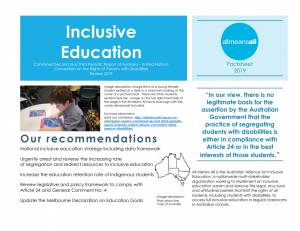
All Means All has prepared a Fact Sheet on Inclusive Education for the United Nations Review of the Combined Second and Third Periodic Report of Australia – Convention on the Rights of Persons with Disabilities.  It is based on our submission to this process, which you can read here.

The review is taking place in September during the 22nd Session of the Committee and will be attended by delegates from Australia including All Means All.

You can view and print the Fact Sheet in accessible PDF here.

Filed Under: News, Uncategorized

  • 1
  • 2
  • Next Page »

About Us

All Means All is the Australian Alliance for Inclusive Education, a nationwide multi-stakeholder alliance working together to implement an inclusive education system and remove the legal, structural and attitudinal barriers that limit the rights of some students to access full inclusive education.

Want to learn more

Sign up for all the latest news and resources straight to your inbox.

  • Terms of Use
  • Privacy Policy
  • Copyright
  • Accessibility
  • WordPress Site by Meta Creative